
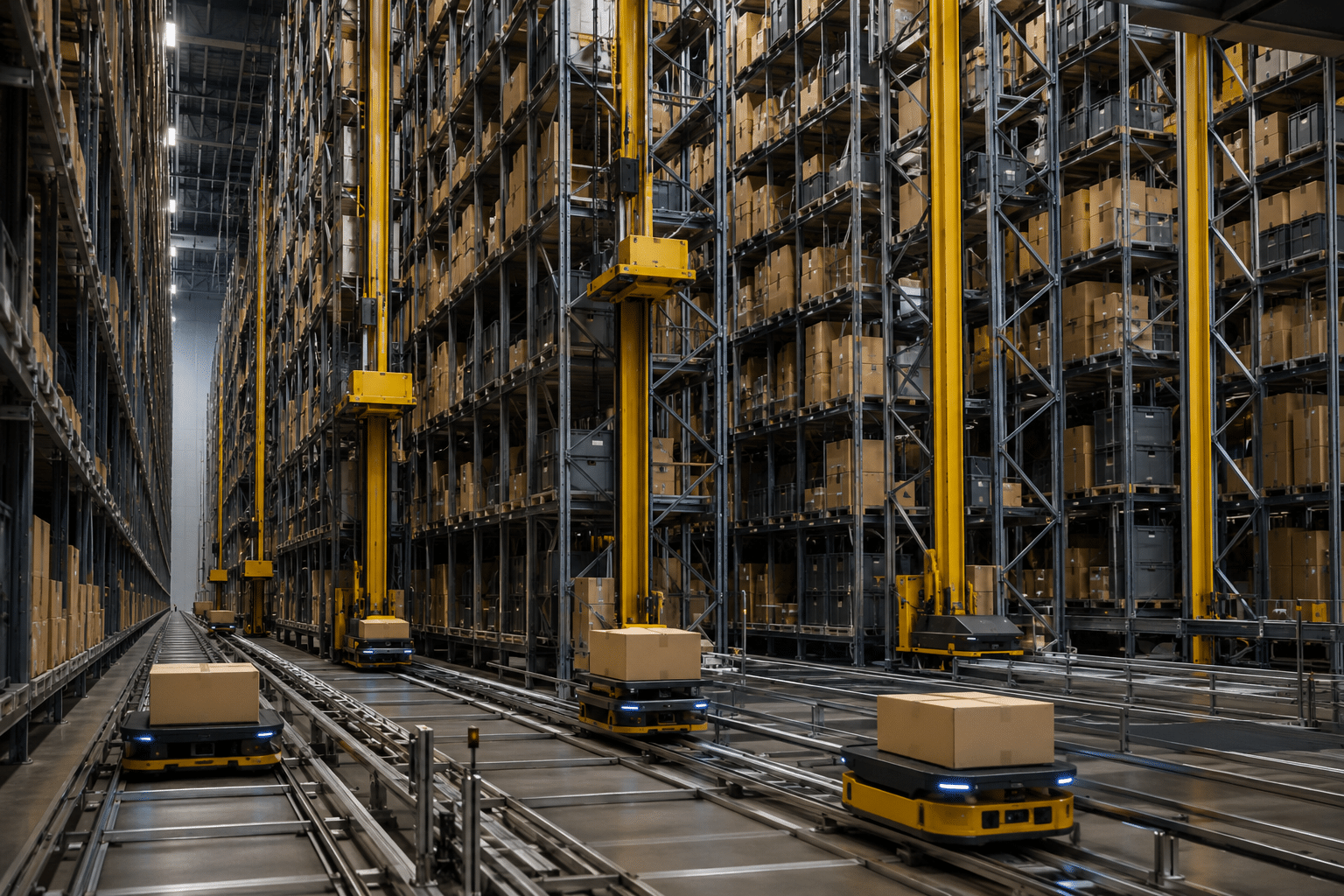
Warehouse teams are being asked to move more volume, in less space, with fewer people and fewer mistakes. As order profiles fragment and labor stays tight, a robotic automated storage and retrieval system has become one of the most reliable ways to hold throughput without adding square footage.
The idea is simple even when the engineering is not, and it is the same idea behind every form of automated storage. Machines, racking and control software work together to store, track and deliver inventory on demand, so goods come to the operator instead of the operator walking to the goods. That single change removes most of the travel time from a warehouse, and travel is where the majority of picking labor has always gone.
At SOURCE Racks we design and install the racking these systems run on, including retrofits into buildings that were never designed for robots. Here is how the technology works, what the main formats do well, and what your building actually needs to support one.
What Is an Automated Storage and Retrieval System
An automated storage and retrieval system, usually shortened to ASRS, is a combination of machines, racking and control software that stores and retrieves goods with little or no manual handling.
An operator or a connected warehouse management system releases an order. The ASRS system locates the required load, retrieves it, and delivers it to a pick station. Every movement is recorded, so the system always knows the exact storage location of every pallet, tote and carton it holds.
The practical result is that the storage area becomes a database with a physical form. Inventory control stops depending on someone walking an aisle with a clipboard, and inventory accuracy stops being a monthly surprise. For most warehouse operations, that inventory management gain arrives before the labor savings do.
Two things are worth separating up front. Automated storage refers to how goods are held and moved inside the structure. Warehouse automation is the broader category, including conveyor, sortation, robotic palletizing and automated guided vehicles that move loads between areas. An ASRS solution is usually the dense storage core that the rest of the warehouse automation feeds.
The Main Types of ASRS Technology
Not every building needs the same machine. ASRS technology spans several formats, and the right one depends on the load, the throughput target and the height you have to work with.
Unit Load and Mini Load Stacker Cranes
A stacker crane runs on a fixed rail inside a narrow aisle, traveling horizontally and vertically to store and retrieve loads from racking on both sides.
Unit load cranes handle full pallets and are the classic choice for high bay buildings, often reaching 80 to 100 feet where a forklift stops being practical well below that. Mini load ASRS cranes do the same job at a smaller scale for totes, cartons and bins, feeding goods to person stations at high pick rates.
Cranes give the best storage density per dollar in tall buildings. The tradeoff is that one crane usually serves one aisle, so throughput scales by adding aisles rather than by adding machines.
Shuttle Systems and Robotic Shuttles
A shuttle system puts robots inside the racking itself. Shuttle robots ride rails on each level, moving bins and totes to a lift at the end of the aisle, which passes them to a conveyor or straight to a pick station. It is the format drawing most new automation investment right now.
A shuttle based ASRS decouples horizontal and vertical movement, which is why it hits far higher throughput than a crane serving the same footprint. It also scales gracefully. Add shuttles to raise throughput, add levels to hold more inventory, without rebuilding the system around it.
Shuttles suit high velocity operations with a lot of order lines and small to medium loads. Ecommerce fulfillment, parts distribution and retail replenishment are the common use cases.
Autonomous Mobile Robots and Cube Storage
An autonomous mobile robot navigates the floor rather than riding a rail. Some fleets lift and carry mobile racks of inventory to a station, others climb a grid of stacked bins and pull individual items from the top down.
These formats are the most flexible option available. They deploy into an existing building with minimal fixed structure, expand a few units at a time, and can be relocated if you move. Where a crane installation is a construction project, an ASRS robot fleet is closer to an equipment purchase, which is why so many operations start here.
Automated guided vehicles fall into the same family but follow fixed paths using floor markers, magnetic tape or lasers, which makes them a good fit for repetitive pallet moves between defined points.
Vertical Lift Modules and Carousels
A vertical lift module is an enclosed tower of trays with an internal extractor that delivers the requested tray to an ergonomic window. It is the most compact form of vertical storage available and it recovers floor space immediately, which is why maintenance rooms, tool cribs and spare parts operations use them heavily.
A vertical carousel rotates trays around a closed loop to bring the right one to the operator. A horizontal carousel does the same thing on a horizontal plane, and pods of two or three horizontal carousels can be worked together so a picker is always at a presented face while the others rotate, which keeps individual items coming without anyone walking. Every carousel format shares the same logic, move the inventory, not the person.
None of these will run a full distribution center on their own. For small parts, high SKU counts and moderate throughput, a carousel or enclosed tower is often the fastest payback in the building.
How Robotic Storage Increases Density and Space Utilization
Conventional racking wastes two things, aisle space and air. Forklift aisles consume a large share of the floor, and most buildings stop stacking well below the roof because people and lifts have practical limits.
Automated storage takes both back. Machines work in aisles too narrow for a forklift, or eliminate aisles entirely in cube based systems, and they reach heights no operator can safely work at, stacking items far above conventional rack. High density storage configurations routinely hold three to five times the inventory of conventional racking in the same warehouse space, and warehouse automation is often justified on that recovered capacity alone.
Better space utilization changes the math on expansion. When an existing building absorbs the next few years of growth, a lease renewal replaces a relocation, and that avoided cost is usually larger than the automation itself. Storage capacity you already own is always cheaper than storage capacity you have to go lease.
Faster Picking, Fulfillment and Throughput
Goods to person picking is where automation proves itself. A picker standing at a station handles several times the lines per hour of a picker walking an aisle, with less fatigue and a much lower error rate, because the retrieval process delivers the right bin to a fixed point every time.
Accuracy improves for a structural reason, not a motivational one. When the system presents one tote and lights the correct compartment, the opportunity to pick the wrong SKU largely disappears. Operations that automate picking typically see error rates fall by an order of magnitude.
There is a reverse logistics benefit too. Returns are slow to process manually because every returned unit has to be found a home in the warehouse. An ASRS puts returned items back into any open storage location and records the inventory move, so restocking stops competing with outbound work.
The pattern is consistent. Machines take the repetitive movement, people keep the judgment, quality checks and exception handling.
How ASRS Connects to the Rest of Your Warehouse Operations
A robotic system is never an island. It connects to conveyor, packing, shipping and your existing software, and the integration is usually the harder half of the project.
Three layers have to talk to each other. The warehouse management system owns inventory, orders and business rules. The warehouse control system sits underneath it and directs the physical equipment, sequencing cranes, shuttles, conveyor and sortation so the right load arrives at the right station in the right order. The machine controls execute. When these projects disappoint, the cause is far more often an integration gap between these layers than a shortcoming in the hardware.
Good news for phasing. Because these automated systems are modular, most operations start with one zone, prove the flow, and expand. You do not have to shut down a building to modernize it.
What Robotic Storage Demands From Your Racking
This is the part that gets underestimated, and it is the part we get called about after the fact.
Robots do not tolerate what forklift operators absorb without noticing. A crane, a shuttle or a mobile robot needs the structure it runs in to be built and held to tolerances measured in millimeters, not inches.
Precision Rail-guided equipment needs storage racks that are plumb, square and dimensionally consistent from the first bay to the last. Beam elevations that vary bay to bay stop a shuttle.
Floor flatness Cranes and mobile robots both depend on a floor within tight tolerance. Existing slabs frequently need survey and localized grinding before equipment goes in.
Structural capacity Rack-supported buildings and high bay systems concentrate loads very differently than conventional pallet racking. Seismic requirements in California, Arizona and much of Texas drive heavier engineering than most people expect.
Guarding and access Automated aisles need physical separation from people, plus safe maintenance access and code compliant fire protection, including in-rack sprinklers and flue spacing designed in from the start.
Room to grow Leaving space for additional aisles, charging areas and conveyor runs at the design stage costs almost nothing. Retrofitting them later costs a great deal.
The practical takeaway is that automation readiness is a racking decision made years before the robots arrive. A conventional pallet racking system engineered to automation tolerances today can be retrofitted later. One that was not usually has to be replaced.
Build the Right Foundation With SOURCE Racks
Every automated storage and retrieval system still stands on engineered steel. Cranes, shuttles and mobile robots need precise, permitted, code compliant structures to run safely, and that is what we do.
SOURCE Racks designs, engineers, permits and installs racking built for warehouse automation, seismic compliance and long term performance, across California, Texas, Arizona, Georgia and nationwide. We have laid out racking around third party robotics systems, including a recent project in Grand Prairie, Texas where the rack design followed the robots rather than the other way around, and we regularly assess existing racking for automation readiness before a client commits to equipment.
If you are evaluating a robotic automated storage and retrieval system, or planning a building that will need one in a few years, talk to us before the racking is set. Getting the foundation right is the cheapest part of the project and the most expensive one to redo.
[Get an Estimate] → /contact-us/ Call (949) 822-8653