
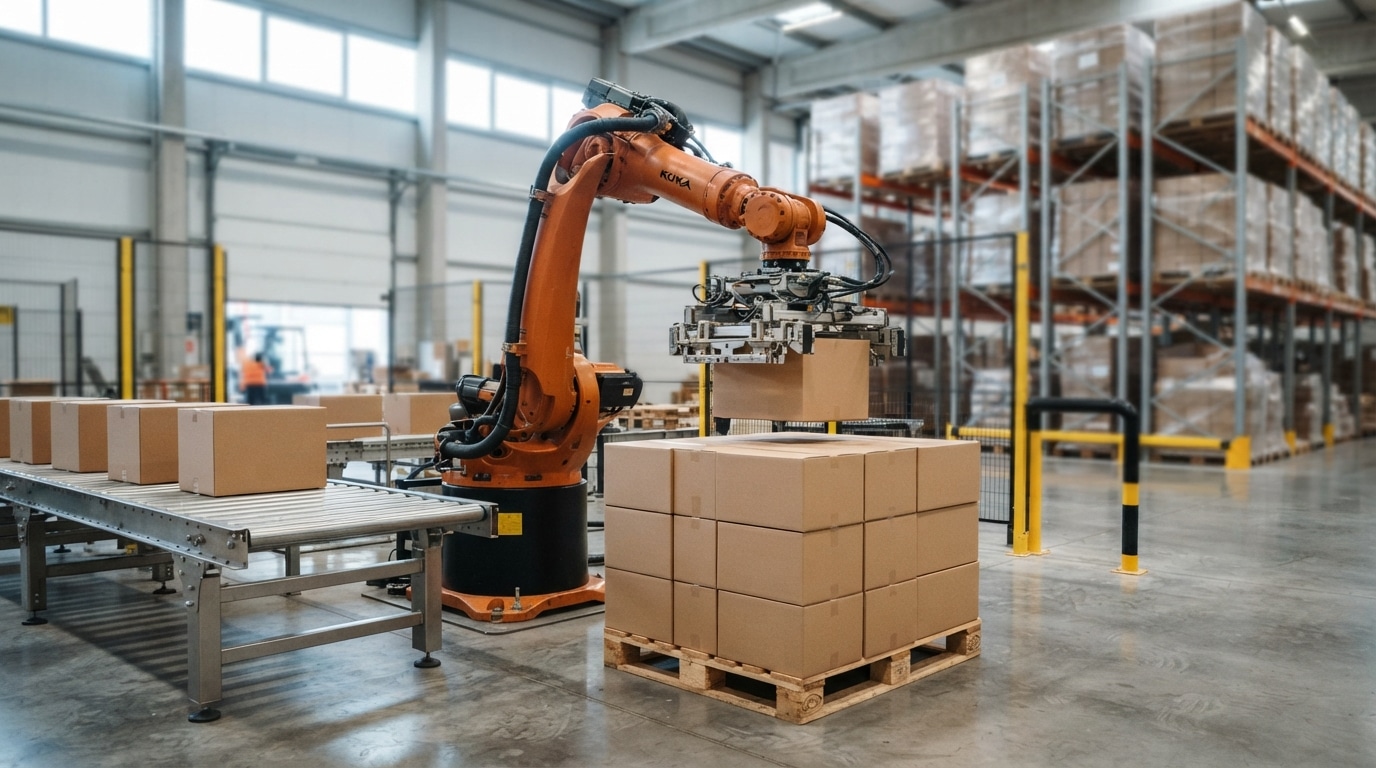
Few upgrades change the rhythm of a warehouse as quickly as a robotic palletizing system. The end of the line is where product either flows or bottlenecks, and for decades that final palletizing task fell to people stacking cases, bags, and pails by hand. Today, robotic palletizing has moved from a luxury reserved for massive plants to a practical, scalable solution for facilities of nearly any size. If your operation is wrestling with labor gaps, inconsistent pallet patterns, or throughput that stalls at the wrap station, this guide will show you how a robotic palletizer works, where it pays off, and how to plan for one.
What Is a Robotic Palletizing System?
A robotic palletizing system is an automated cell that stacks products onto a pallet using a programmable robot instead of manual labor. At its core sits a robotic arm — often a FANUC robot or comparable industrial robot — paired with end-of-arm tooling, a pallet dispenser, and infeed conveyor. Product arrives on a pallet conveyor or case conveyor, the robot arm identifies each item, and the gripper places it according to a pre-programmed pallet configuration. The result is a tightly built, repeatable load every single time.
Compared to conventional palletizers and older layer palletizers, robotic palletizers are far more flexible. A conventional palletizer is built to run one pattern at high speed; a robotic palletizing solution can switch pallet patterns on the fly, handle multiple SKUs, and adapt to new products with a software change rather than a mechanical rebuild. That flexibility is why automated palletizing has become the default choice for warehouses managing growing SKU counts and shorter production runs.
The Core Components of a Robotic Palletizer
Understanding the hardware helps you scope the right palletizing system for your operation. Every robotic palletizing cell is built from a handful of key elements working in concert.
The robot and payload. The industrial robot is the heart of the cell. Its payload rating — the maximum weight it can lift, including the tooling — determines what you can stack. A palletizing robot handling light cartons needs far less payload than one building a robotic bag palletizer line moving 100-pound sacks. Matching payload to product is the single most important spec in any palletizing solution.
End-of-arm tooling and the gripper. Arm tooling is what actually grabs the product. A vacuum gripper suits smooth cases, a clamp handles bags in bag palletizing, and specialized tooling manages pails, drums, and irregular items. Good tooling is what separates a robotic system that runs reliably from one that jams. Many integrators, including firms like Kaufman Engineered Systems, custom-design tooling around each application.
Conveyor and infeed. A conveyor delivers product to the cell in a controlled orientation. The pallet conveyor and pallet dispenser feed empty pallets in and move finished loads out, keeping the palletizing process continuous.
Controls and pattern software. Software defines the pallet configuration and pallet patterns, letting operators load new stacking recipes in minutes. This is where a robotic palletizing system truly outshines an automatic palletizer locked to a single format.
Robotic Palletizing vs. Manual Palletizing
Manual palletizing is one of the most physically punishing jobs in any warehouse. Manual handling of cases and bags all shift is a recipe for fatigue, repetitive-strain injuries, and turnover. When you automate the palletizing task, you remove workers from those repetitive tasks and redeploy them to higher-value roles in your operation.
The numbers tend to favor automation. A single robotic palletizer can often match or exceed the output of several people while running consistently across every shift. Because the robot builds identical loads every cycle, pallet stability improves, product damage drops, and trailers load tighter. For high-volume lines, robotic palletizing systems deliver the kind of predictable material handling that manual palletizing simply cannot sustain.
That said, automation is not all-or-nothing. Many facilities blend approaches, using a robotic palletizing solution on their highest-volume lines while keeping manual stations for low-runners.
Cobot Palletizers: Automation for Smaller Operations
Not every warehouse needs a full-speed industrial cell. The rise of the cobot palletizer — built around a collaborative robot — has made automated palletizing accessible to smaller and mid-sized operations. A collaborative robot is designed to work safely alongside people, often without full guarding, so it slots into tight footprints where a large industrial robot won’t fit.
Collaborative robots typically run at lower speed and payload than their industrial cousins, but for a line producing a few pallets an hour, a cobot palletizer offers a fast return with minimal disruption. It’s an ideal entry point for a business taking its first step into palletizing automation.
Choosing the Right Palletizing Solution for Your Warehouse
Selecting a palletizing system starts with your product and your throughput. Ask how heavy your items are (payload), how many SKUs and pallet patterns you run, and how fast the line needs to move. A high-speed beverage line and a low-volume specialty producer need very different robotic palletizers.
Layout matters too. The palletizing cell has to integrate with your existing conveyor, your rack system, and your outbound staging. This is where warehouse racking and automation planning intersect — the way product flows into the cell and how finished pallets feed into storage directly affects the efficiency of the whole operation. Designing racking and material handling around your automation, rather than bolting a robot onto a fixed layout, is what unlocks real throughput gains.
Finally, think about the future. Industrial palletizing robots and automated palletizing systems are software-driven, so a well-specified cell can adopt new products and new pallet configurations for years. Building in that headroom protects your investment as your inventory and order profile evolve.
Integrating Palletizing Automation With Your Racking and Storage
A robotic palletizer doesn’t operate in isolation — it’s one node in a larger material handling network. Finished pallets have to go somewhere, and that’s where thoughtful storage design pays off. Automation-ready racking, pallet flow lanes, and clear staging keep the palletizing process from backing up. When the handling downstream of the robot is engineered to match its output, the entire warehouse moves faster.
SOURCE Racks designs warehouse racking and storage systems built to leverage conveyors, robotics, and automation. Whether you’re planning your first cobot palletizer or scaling a fleet of industrial palletizing robots, we help you build the layout and rack structure that lets your palletizing solution perform at its best.
The Bottom Line on Robotic Palletizing Systems
A robotic palletizing system is one of the highest-impact automation investments a warehouse can make. It relieves your team of dangerous manual handling, delivers consistent pallet quality, and scales with your business. From a single collaborative robot to a full line of robotic palletizers, the technology has never been more accessible — and the operations that adopt it are pulling ahead on cost, safety, and speed.
Ready to design a warehouse layout that’s built for automation? Contact SOURCE Racks for a fast, expert consultation on racking and storage that keeps pace with your robotic palletizing goals.
[Get Estimate] — Call (949) 822-8653 or request your free estimate online.
Suggested FAQ
How much does a robotic palletizing system cost? Cost depends on payload, speed, tooling, and integration. A single cobot palletizer is the most affordable entry point, while high-speed industrial palletizing robots with custom arm tooling and conveyor cost more. Most facilities see the investment repaid through labor savings and consistent throughput.
Can a robotic palletizer handle bags and pails, not just cases? Yes. With the right gripper and end-of-arm tooling, robotic palletizers handle cases, bags (robotic bag palletizer applications), pails, drums, and mixed loads. Tooling is matched to your product for reliable handling.
Is a cobot palletizer right for a small warehouse? For lower volumes, a collaborative robot is often the ideal solution — compact, safe to run near people, and quick to deploy without a full guarding rebuild.