
Pallet flow racking is a gravity fed, high density storage system built for FIFO throughput and warehouse efficiency. Pallets load on one side, roll across inclined rollers, and reach the pick face in the order they arrived, so the oldest inventory always ships first and no lift truck ever drives into the rack.
SOURCE Racks designs, engineers, and installs pallet flow racking across California and nationwide. For food, beverage, cold storage, and high velocity fulfillment, a pallet flow system trades wide aisles for deep storage rows and turns the same square footage into more pallet positions and faster picks.
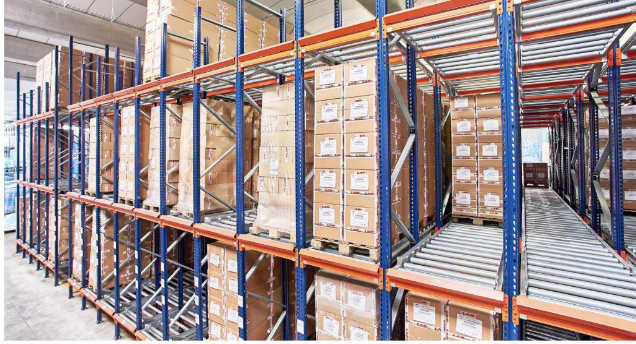
Pallet flow is a pallet rack system with inclined roller tracks in place of open shelf levels. Loads enter on the loading side, gravity carries them toward the front, and they queue at the pick face until an operator pulls them.
A complete system includes:
Each flow lane runs on a shallow pitch, usually about half an inch of drop per foot, which is enough for smooth flow without letting speed build.
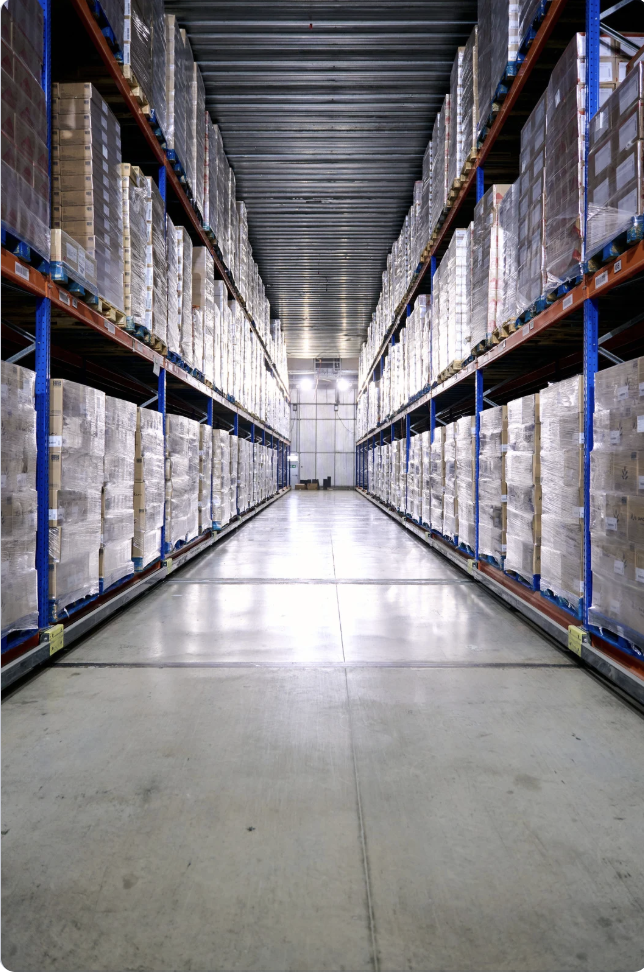
The mechanics are simple, which is why the system is so reliable.
A lift truck sets a pallet on the high end of the row.
Gravity moves it down the rollers toward the pick face.
Speed controllers meter the descent so it arrives at a walking pace.
As one pallet is pulled, the next advances on its own.
The row refills from the back while picking continues at the front.
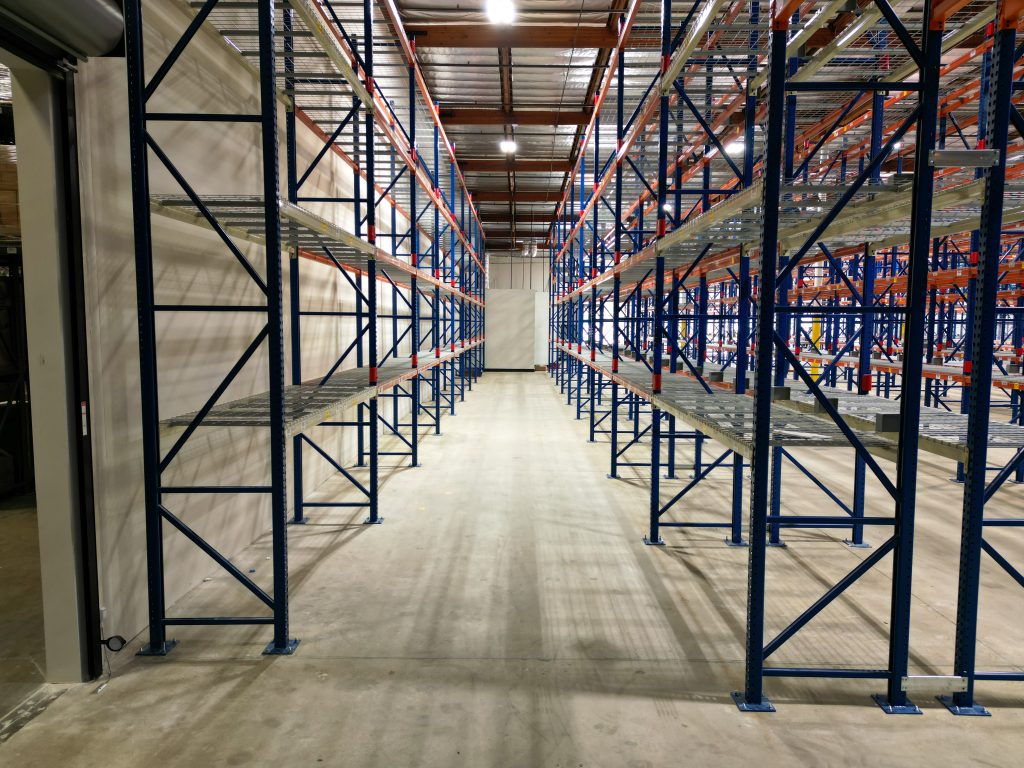
Because loading and picking happen on opposite faces, the two never cross. That single change removes most of the aisle congestion and forklift travel that slows a conventional rack layout.
Component quality is what separates a system that runs for fifteen years from one that jams in its first season.
Wheel rails for lighter pallets and full width roller tracks for heavy or weak bottom pallets.
01Steel, polymer, or galvanized based on temperature, moisture, and product weight.
02Centrifugal units engage only when a pallet runs too fast, so a light pallet is never stalled.
03Hold the queue back so an operator can pull the front pallet cleanly.
04Uprights, beams, and bracing engineered for full capacity, not just the pallet at the front.
05Keep placement accurate and protect the frame from lift truck contact.
06Every build gets load testing and a speed adjustment pass at commissioning, so every row runs at the same rate on day one.
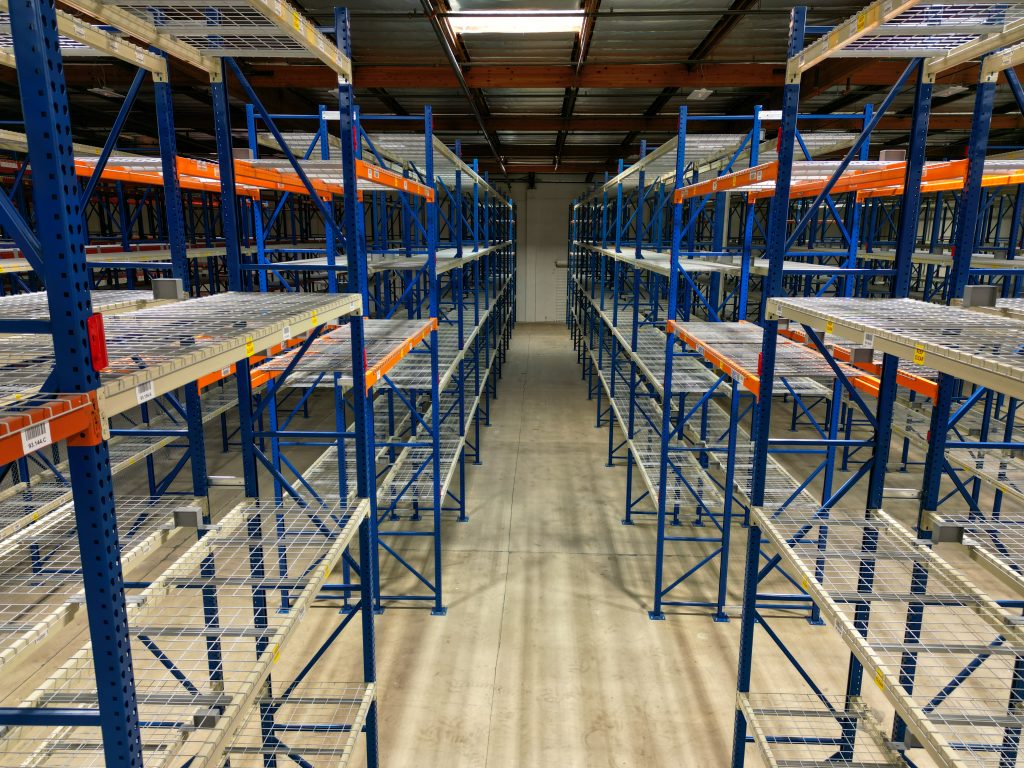
Load one side, pick the other, and FIFO happens on its own. No date checking, no manual rotation, no expired product sitting at the back.
01Deep storage rows replace aisles. A pallet flow system commonly holds 60 percent more pallets in the same floor space than selective pallet rack, which is why it pays back fastest in expensive markets.
02Pick faces stay full and travel distance drops, so pick rates climb without adding labor. Operators spend their time moving product instead of hunting for it, and picking efficiency rises across every shift.
03Trucks never drive into the storage rows, so rack impacts, product damage, and repair costs all fall.
04One SKU per row means counts are visual, replenishment triggers are obvious, and cycle counting takes a fraction of the time.
05Pallet flow is a strong fit when:
It is a weaker fit for slow movers, one off pallet profiles, or a catalog with hundreds of low volume SKUs, where selective pallet rack or a hybrid layout usually wins. We will tell you when that is the case.
Common applications include food distribution, cold storage, bottling and manufacturing, third party logistics, and high velocity ecommerce fulfillment.
| System | Rotation | Density | Best for |
|---|---|---|---|
| Pallet flow | FIFO | High | High volume, few SKUs, date sensitive product |
| Selective pallet rack | Any | Low | Broad SKU counts and direct access |
| Drive in rack | LIFO | High | Bulk storage where rotation does not matter |
| Push back rack | LIFO | Medium to high | Two to six deep with mixed SKUs |
| Carton flow | FIFO | High | Case and each picking, not full pallets |
| Cantilever rack | Any | Low | Long or bulky material |
A gravity flow rack layout and a push back layout look similar on paper, but they rotate in opposite directions. Choosing wrong is expensive to unwind, so we model both against your real order profile before quoting.
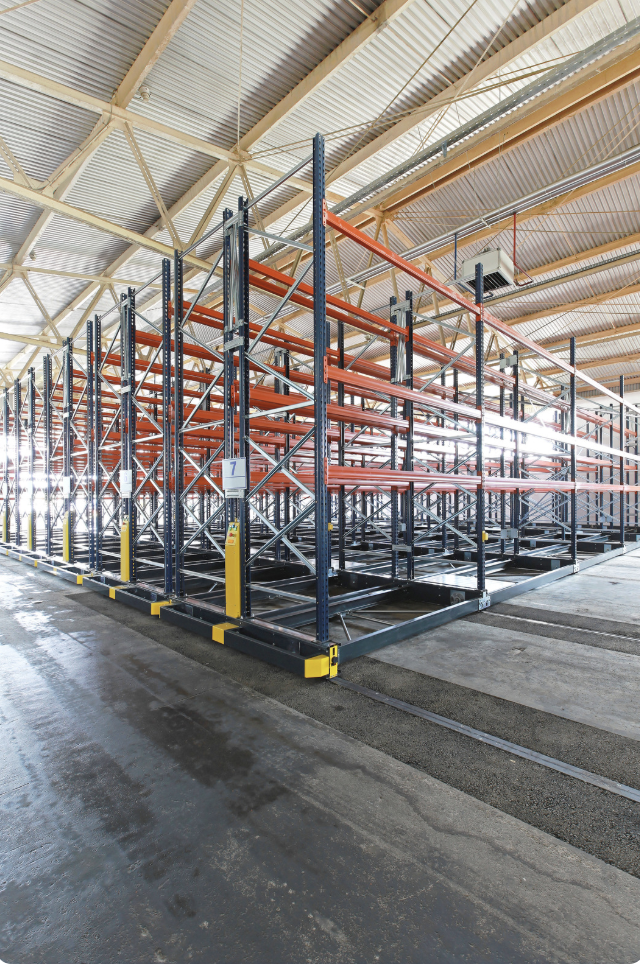
Pallet flow carries heavy concentrated weight and moving product, so the engineering matters more than it does on a static rack.
A wide range of pallet profiles, temperatures, and building conditions can be accommodated, but only when the design starts with your actual pallets rather than a catalog assumption.
California runs the tightest and most expensive industrial real estate in the country, which makes storage density and warehouse efficiency the whole game.
Warehouses in Ontario, Fontana, and Rialto use pallet flow to push more pallet positions into Inland Empire buildings without adding square footage. Warehouse operations near Los Angeles, Long Beach, Carson, and Compton use gravity fed rows to keep port bound freight moving on schedule. Logistics hubs including Chino, Jurupa Valley, Moreno Valley, Santa Fe Springs, Commerce, and Vernon rely on flow lanes for fast turning food and beverage inventory.
We also design around the California specifics that out of state suppliers miss, including seismic bracing, local plan check standards, and sprinkler rules that change once you add rail and decking to a bay.
CASOURCE Racks is a Southern California company with sourcing and installation reach across the country. We ship and install from regional bases near Seattle, Los Angeles, Phoenix, Dallas, Chicago, Atlanta, and New Jersey, which shortens freight distance and lowers landed cost on every project.
That footprint covers the major logistics corridors, including the Inland Empire, Dallas Fort Worth, Houston, Phoenix, Atlanta, Savannah, Chicago, Central Pennsylvania, and the Northern New Jersey port market. Pallet flow rack systems roll out to the same standard in every warehouse we touch.
USMost run two to twenty pallets deep. Past that, accumulated weight and pitch requirements start working against each other, and a different design usually serves the operation better.
Speed controllers hold pallets to roughly 30 to 60 feet per minute, slow enough to stop safely at the pick face and fast enough to keep the system refilling itself.
Yes, with the right roller material, low temperature lubricants, and brake units rated for cold. Cold storage is one of the strongest use cases because dense rows cut the cubic footage you pay to keep frozen.
Consistent GMA style pallets run best. Damaged stringers, plastic slave pallets, and mixed footprints all change the rail selection, so send a photo and the dimensions and we will spec around what you actually use.
Most installs run six to twelve weeks from approved drawings through commissioning, with permit timing as the biggest variable. Ask about current lead times when you request an estimate.
An annual rack inspection, a look at wheel and brake wear, and a quick speed check. That is the whole process.
If your warehouse is full but your volume is still climbing, pallet flow racking is one of the few storage solutions that adds capacity without adding rent.
Send us your building dimensions, pallet dimensions and weights, SKU count, and a short description of how product moves through the operation. We will come back with a lane layout, a capacity number, and an installed price. Required fields on the estimate form take about a minute to complete.