
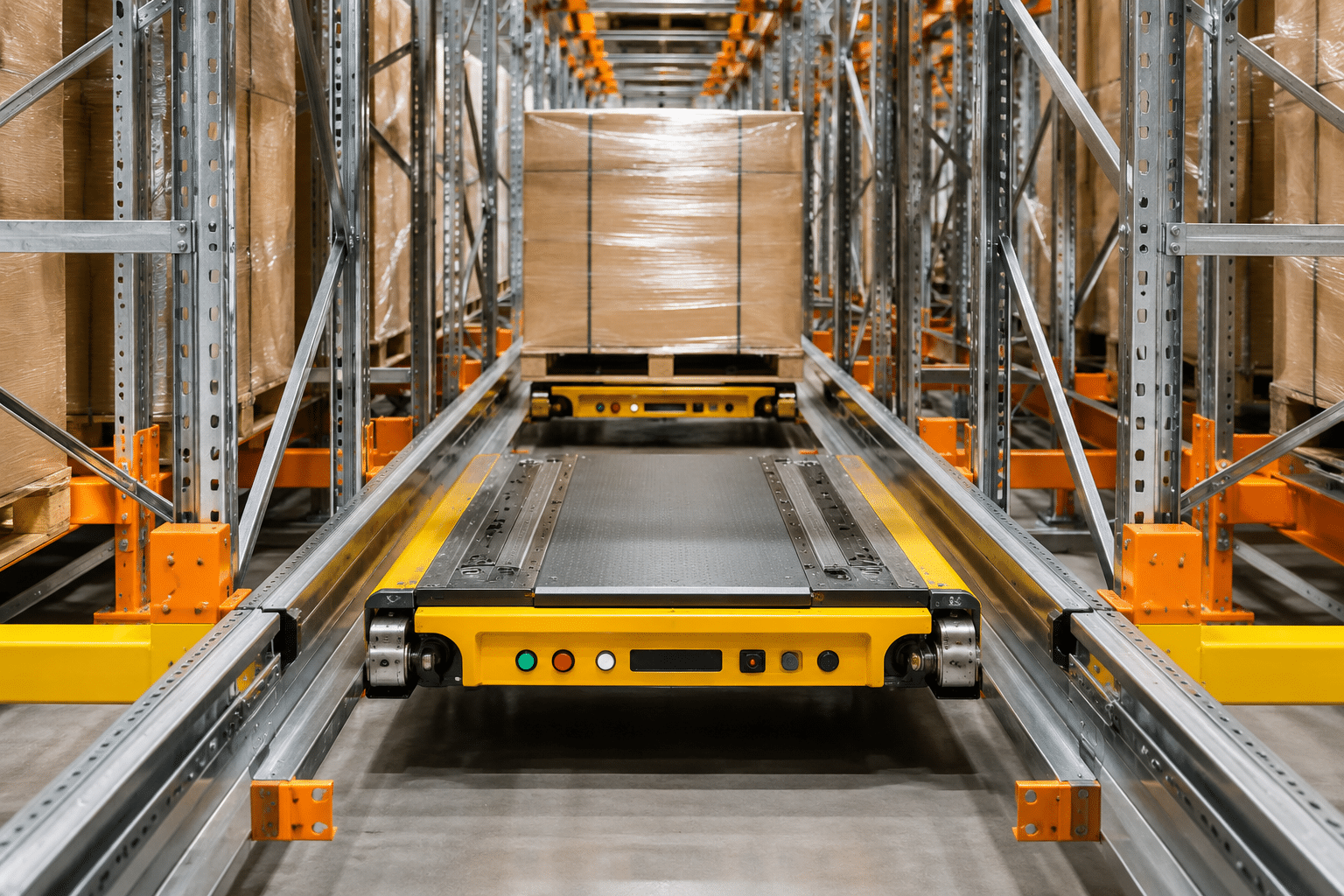
Warehouses tend to run out of room long before they run out of business, and the fix is rarely a bigger building. A pallet shuttle reclaims wasted volume by storing pallets many positions deep, then using a motorized shuttle to move each pallet in and out for you. Instead of driving a forklift down every lane, the pallet shuttle handles the deep travel while the operator waits at the face. The payoff is a denser warehouse, faster retrieval, and far less forklift traffic on the floor.
How a Pallet Shuttle System Works
A pallet shuttle system is built from three parts, the rack, the rails, and the shuttle itself. Deep rows hold load beams on each side, and steel rails run the length of every storage channel. A forklift or reach truck sets the motorized shuttle into place, then feeds pallets one at a time at the channel entrance. The shuttle lifts each pallet, carries it down the rails, and compacts the load deep in the row before coming back along the rails for the next pallet.
Because the operator drives the shuttle from a tablet, one worker can run continuous loading and retrieval. The forklift never enters the lane, which removes forklift travel and protects the racking structure from impact. Pallet shuttles support both LIFO from a single aisle and FIFO through two aisles, so the same system can serve a freezer, a staging area, or a busy distribution dock. Many warehouse teams add pallet shuttles a few at a time as demand grows.
Deep Lane Storage and Space Utilization
The reason warehouses adopt pallet shuttle systems is density. A traditional drive-in layout limits depth because a lift truck must enter the lane, but deep lane storage with a shuttle can run dozens of pallets into one storage channel. Each storage lane holds far more product, travel paths shrink to only what access requires, and space utilization across the warehouse climbs sharply.
That reclaimed warehouse space turns into more pallet storage without a new lease. By collapsing wide drive paths into compact channels, a shuttle lifts capacity well beyond selective pallet rack while keeping every pallet position reachable. Fewer trucks in the racks also mean less forklift traffic and safer storage operations for the whole warehouse team.
Semi Automated and Automated Pallet Shuttle Options
Most sites start with a semi automated pallet shuttle, where a forklift repositions the shuttle and a driver directs it by tablet. When throughput climbs, an automated pallet shuttle takes the forklift out of the cycle entirely. In a fully automated pallet shuttle setup, transfer cars and lifts move the shuttle between levels and rows on their own, turning the system into a compact automated storage and retrieval system.
The most advanced option is the 3D automated pallet shuttle, which adds vertical and horizontal movement so an automated shuttle can reach any pallet position in the block. This pallet shuttle automation competes with stacker crane systems and conveyor systems, yet it installs inside standard rack and scales as your warehouse automation plans grow. A pallet shuttle racking system laid out this way delivers automated pallet storage at a fraction of a full crane build.
Pallet Shuttle Versus Other Racking
Compared with pallet flow racking, a pallet shuttle moves heavier throughput without gravity rollers and handles both FIFO and LIFO. Compared with drive-in pallet racking, it keeps lift trucks out of the lane and cuts damage. It is not the right fit for every load, and long or awkward stock may still call for cantilever racking, but for uniform pallets it is one of the densest systems on the market.
The system also reshapes your fleet. With the shuttle doing the deep travel, a warehouse operation needs fewer reach trucks and counterbalanced trucks in the racks, which can shrink a rental fleet or the rental trucks you bring in for peak season. Teams still lean on hand pallet jacks and forklifts at the dock, but forklift travel deep in storage all but disappears, along with the truck traffic that dings the racking structure.
Why Warehouses Choose the Pallet Shuttle
Warehouses choose pallet shuttle systems for three reasons, density, speed, and safety. Retrieval is faster because the shuttle stages the next pallet while the operator handles the last one. Product stays protected because the deep travel never touches the rack face or the door equipment near the dock. And every reclaimed foot of warehouse space becomes usable storage that keeps storage operations smooth shift after shift.
For high volume, single SKU inventory, few systems match pallet shuttles for return on floor space. Whether you run a semi automated shuttle system today or plan for a 3D automated pallet shuttle tomorrow, the layout grows with you and keeps the warehouse dense.
Get Started With SOURCE Racks
Ready to see what a pallet shuttle could do for your building. The team at SOURCE Racks designs, engineers, and installs pallet shuttle systems and high density rack built around your pallets, your lanes, and your throughput. Reach out through the form below and we will map the right pallet shuttle system for your warehouse.