
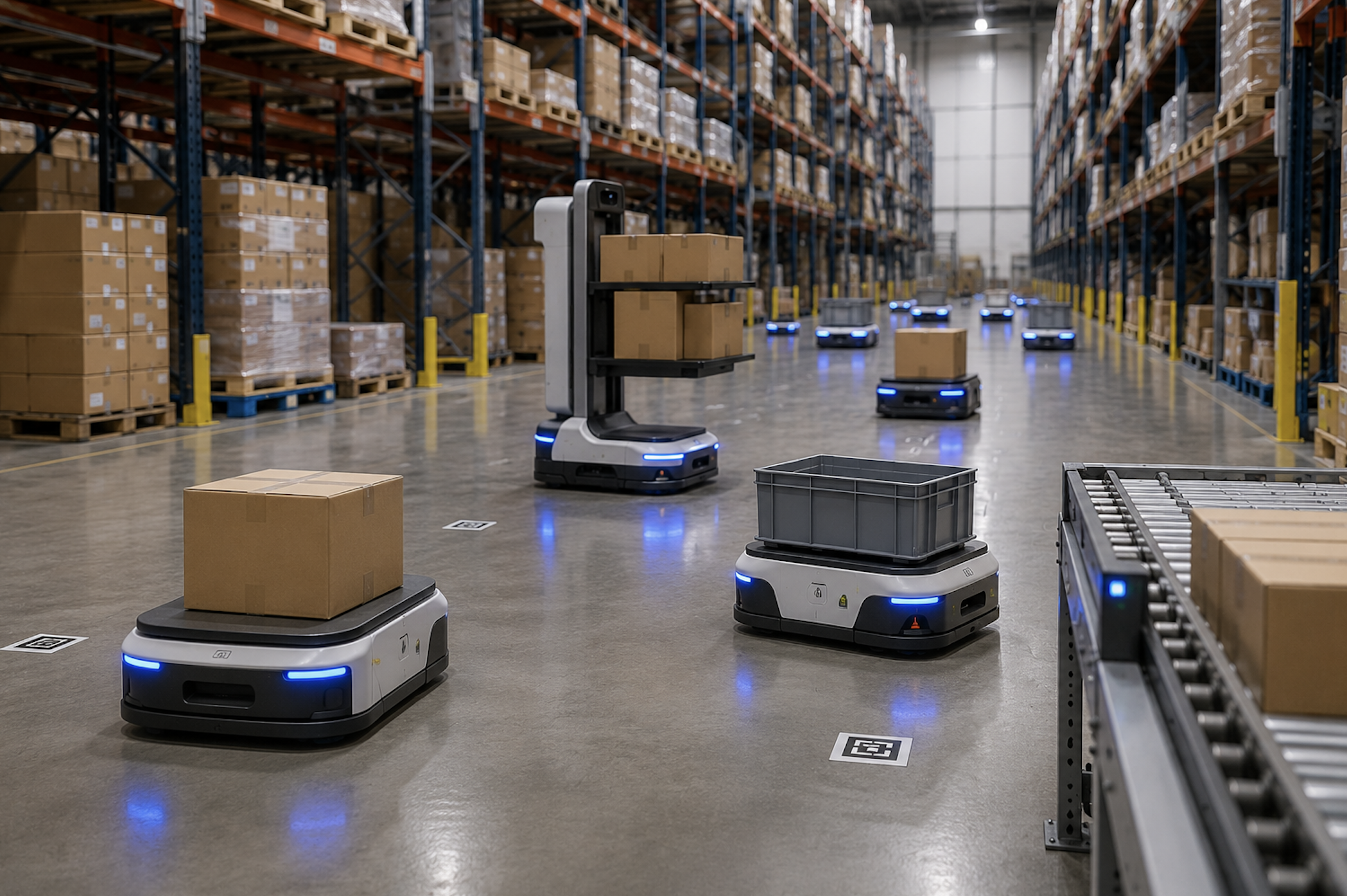
Warehouses are no longer quiet rows of static shelving. Across logistics, manufacturing, and fulfillment, autonomous mobile robots now travel through aisles, carry goods, and work alongside people. For any operation weighing warehouse automation, understanding what these machines do, how they navigate, and how your physical layout shapes their performance is the difference between a smooth rollout and an expensive misstep. This guide breaks down autonomous mobile robots from the ground up, then explains why the racking around them matters just as much as the technology inside them.
What Are Autonomous Mobile Robots
An autonomous mobile robot is a self navigating machine that moves materials and completes tasks without fixed guidance or constant human intervention. Unlike a traditional industrial robot bolted to one spot on a production line, an AMR robot travels freely through a facility, mapping its surroundings and choosing its own route. The term covers a wide family of mobile robots, from compact units that ferry totes to an autonomous forklift capable of lifting a loaded pallet.
What sets autonomous mobile robots apart is decision making. Using onboard sensors and software, each mobile robot perceives its environment, plans a path, and adjusts in real time. This is why mobile robotics has expanded so quickly. A single autonomous robot can absorb repetitive tasks, such as transporting goods between zones, freeing a human worker to focus on judgment heavy work that machines cannot replicate.
How AMRs Differ From Automated Guided Vehicles
People often confuse an AMR with an automated guided vehicle. The distinction matters. An automated guided vehicle follows a fixed path defined by magnetic tape, embedded wires, or floor markers. Change the route and you re engineer the infrastructure. By contrast, autonomous mobile robots map the space and navigate dynamically, which makes them far better suited to a dynamic environment where layouts, inventory, and order priorities shift daily.
That flexibility is the core advantage of AMR technology. Mobile robots reroute around obstacles, recalculate when an aisle is blocked, and safely share a floor with people and equipment. Earlier automation locked companies into rigid flows, while today’s autonomous robots adapt to the work in front of them.
The Technology Inside an Autonomous Mobile Robot
Every capable mobile robot runs on a layered stack of sensing and software. Navigation usually begins with simultaneous localization and mapping, commonly shortened to SLAM. SLAM lets a robot build a map of an unfamiliar space while continuously tracking its own position inside it, so the machine always knows where it is and where it needs to go.
Perception comes next. A modern autonomous mobile robot relies on advanced sensors including lidar, cameras, ultrasonic detectors, and depth sensors. These feed obstacle detection systems that flag people, pallets, and other obstacles in the robot’s path. Paired with obstacle avoidance and collision avoidance algorithms, the machine can slow, stop, or steer around hazards before contact ever happens. Smooth motion control keeps the unit stable while carrying goods through tight aisles.
Intelligence ties it together. Artificial intelligence turns raw sensor data into decisions, and onboard edge computing processes that information locally so the robot can react in milliseconds rather than waiting on a distant server. This local processing is what allows autonomous mobile robots to operate safely in a busy, constantly changing dynamic environment.
Types of Autonomous Mobile Robots
The category is broad. Picking robots support order fulfillment by meeting workers at shelves and carrying selected items back to packing. Delivery robots transport goods between stations, and some are built to operate in outdoor environments, moving materials across yards or campuses. An autonomous forklift or robotic pallet truck lifts and relocates heavy loads, replacing the manual pallet truck runs that wear crews down over a shift.
A growing class adds manipulation. A mobile manipulator combines a wheeled base with a robotic arm, letting one machine both travel and grasp. These mobile manipulators can pick an item from a shelf, load a tote, or tend a workstation. Collaborative robots, engineered to work safely beside people, blur the line even further. A collaborative mobile robot moves freely through shared space while built in safety systems protect every nearby human operator.
Autonomous Mobile Robots in Warehouse Operations and Logistics
In warehouse operations, the payoff is operational efficiency. Mobile robots cut the miles employees walk each shift, speed up picking, and keep goods flowing during demand spikes. Across logistics networks, fleets of autonomous mobile robots can run multiple shifts without fatigue, handling the repetitive task of moving inventory from receiving to storage to shipping.
The real power comes from coordination. A warehouse execution system, or fleet manager, assigns work, sequences tasks, and orchestrates dozens of robots at once. Integrated with a company’s broader automation and software, this turns individual machines into a synchronized workforce. People still matter at every step. The goal of warehouse automation is to remove unproductive movement, not to remove the human worker.
The Companies Driving Mobile Robotics Forward
Several firms have shaped the modern AMR market. Locus Robotics deploys collaborative mobile robots that work beside pickers and has surpassed billions of units picked across its global sites. Fetch Robotics, acquired by Zebra Technologies in 2021, helped popularize cloud managed AMR fleets for logistics and material movement. Mobile Industrial Robots, part of Teradyne, builds autonomous units for transport inside factories and warehouses. Boston Dynamics pushed mobile robotics into tougher terrain with legged and case handling machines designed for demanding tasks. Together these players turned experimental autonomous robots into dependable industrial tools used across the supply chain.
Designing Your Warehouse for Autonomous Mobile Robots
Here is what many buyers overlook. The smartest robot still depends on the racking and storage around it. Autonomous mobile robots navigate aisles, dock at pick faces, and pull from pallet positions, so the physical layout directly shapes their speed and safety. Aisle width, rack height, beam spacing, and clear floor markings all influence how efficiently mobile robots move through a building.
This is where infrastructure planning pays off. Well designed pallet racking creates predictable travel paths and consistent pick locations, which helps obstacle avoidance systems work exactly as intended. Storage density matters too, because the more accessible your goods, the fewer wasted trips your robots make. Before adding an autonomous forklift or a fleet of picking robots, it is worth auditing whether your shelving actually supports the flow you want.
Build the Foundation Automation Depends On
At Source Racks, we help warehouses build the storage backbone that automation runs on. Whether you are preparing for autonomous mobile robots today or future proofing your facility for them, the right racking system lays the groundwork for faster, safer, and more efficient warehouse operations. Reach out to our team to design a layout that gives your robots, and your people, room to perform.