
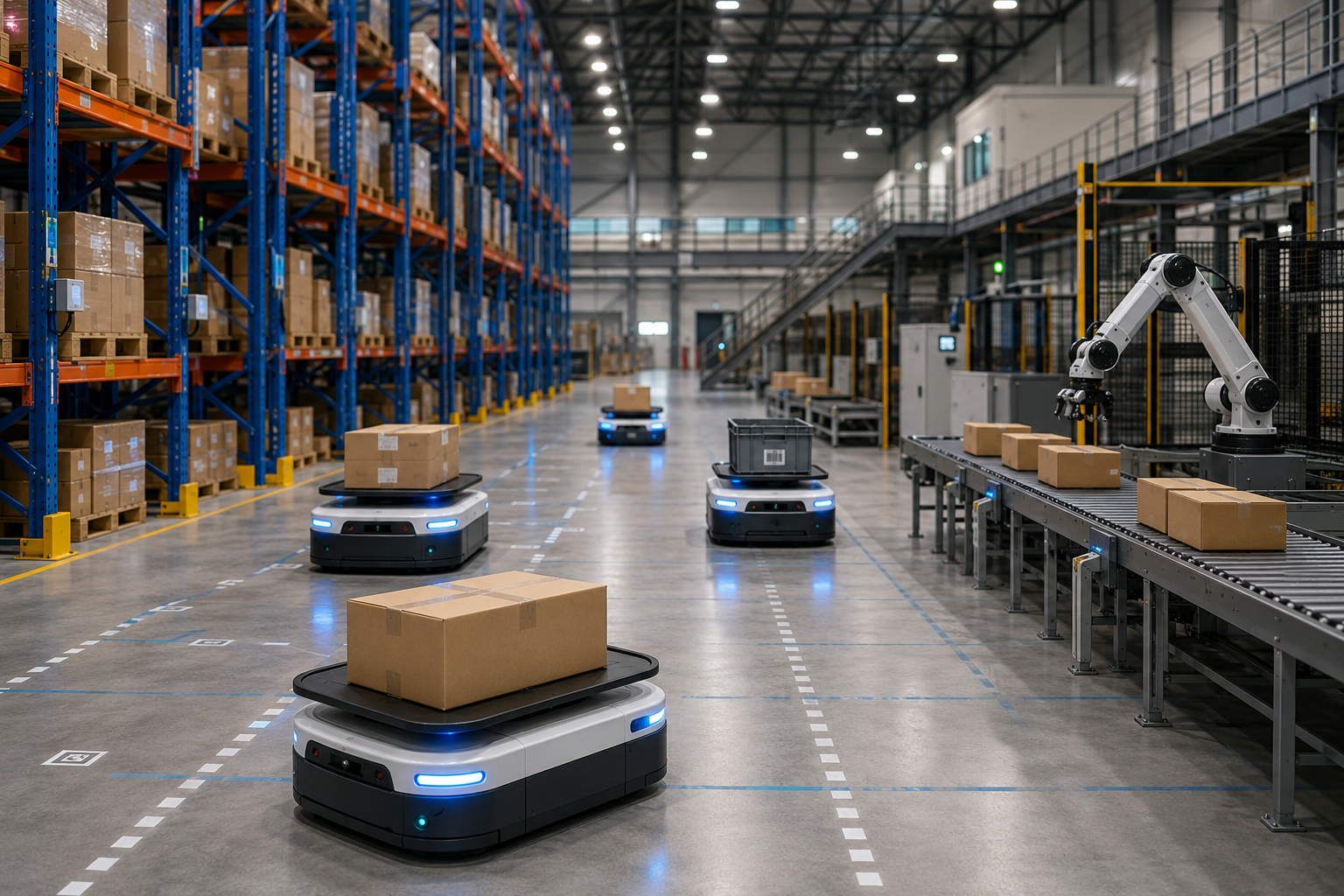
The warehouse of 2025 looks nothing like the warehouse of a decade ago. Where rows of workers once pushed carts and manually palletized goods across hundreds of thousands of square feet, today’s most competitive distribution centers are deploying fleets of autonomous mobile robots — AMRs — that navigate dynamically, adapt in real time, and operate around the clock without fatigue. The AMR warehouse isn’t a futuristic concept anymore. It’s the operational standard that forward-thinking logistics companies are building toward right now.
This guide breaks down everything you need to know: what AMRs are, how they differ from older automation technologies, what they can do inside a warehouse environment, and how to evaluate whether an AMR solution is right for your operation.
What Is an AMR Warehouse?
An AMR warehouse is any warehouse or distribution center that has integrated autonomous mobile robots into its material flow and warehouse operations. The term “AMR” — Autonomous Mobile Robot — refers to a class of self-navigating machines that move through a warehouse without fixed tracks, wires, or magnetic tape embedded in the floor. Unlike older systems, warehouse AMRs use onboard sensors, cameras, and AI-powered software to understand their environment, avoid obstacles in real time, and choose the most efficient path between points.
The result is a fundamentally different kind of warehouse automation — one that adapts to the facility rather than forcing the facility to adapt to it.
AMR vs. AGV: Understanding the Critical Difference
Before diving deeper, it’s worth clarifying a distinction that’s frequently confused: the difference between an AMR and an automated guided vehicle (AGV).
Automated guided vehicles have been used in warehousing since the 1950s. They follow fixed paths — typically defined by magnetic tape, floor-embedded wires, or laser reflectors mounted at specific points. AGVs are reliable and effective for repetitive, predictable routes in stable environments. But they’re rigid. If an obstacle blocks the path, an AGV stops and waits. If your warehouse layout changes, the guidance infrastructure has to change with it.
An AMR robot operates on a completely different principle. Rather than following a predetermined route, an AMR uses simultaneous localization and mapping — commonly called SLAM — to build a real-time map of its environment and navigate dynamically. It knows where it is, where it needs to go, and how to get there, even if the path changes. An AMR encountering an obstacle doesn’t stop — it reroutes.
This distinction matters enormously in real-world warehouse logistics. Facilities with dynamic inventory flows, changing warehouse layout configurations, or high foot traffic can’t afford the rigidity of AGV infrastructure. AMRs flex where AGVs can’t.
How AMR Technology Works Inside a Warehouse
Understanding AMR technology at a functional level helps operators make smarter deployment decisions. Here’s what’s happening inside a warehouse AMR on every shift:
Navigation and Mapping
On initial deployment, an AMR system maps the facility using LiDAR sensors, depth cameras, and sometimes ultrasonic ranging. This map is stored onboard and updated continuously. As the warehouse environment changes — new rack configurations, seasonal floor layouts, temporary staging areas — the AMR updates its internal map accordingly. No facility modifications required.
Path Planning and Obstacle Avoidance
Once a task is assigned, the AMR calculates an optimal route. It continuously scans for obstacles — human workers, forklifts, other robots, spilled goods — and adjusts its path in real time. Modern AMRs can distinguish between a permanent obstacle (a new rack) and a temporary one (a person walking) and respond appropriately to each.
Fleet Management and Task Assignment
In a real AMR warehouse, you’re rarely working with a single robot. Fleets of five, fifty, or five hundred warehouse AMRs operate simultaneously, coordinated by a fleet management software layer that assigns tasks, balances workloads, routes robots around each other, and monitors battery levels to schedule automated recharging without human intervention.
Integration with Warehouse Systems
The most capable AMR warehouse robots don’t operate in isolation — they integrate directly with the warehouse management system (WMS) and, in some cases, with ERP platforms, conveyor systems, and automated storage and retrieval systems. This integration allows AMRs to receive pick orders, confirm completions, update inventory management records, and trigger downstream processes — all without manual labor touching the data.
The Core Use Cases for Warehouse AMRs
AMR warehouse automation isn’t a single application — it’s a platform that supports multiple workflows simultaneously. Here are the primary use cases driving adoption today:
Goods-to-Person Picking
Traditional order picking requires workers to walk miles per shift through warehouse aisles to locate and retrieve items. In a goods-to-person AMR model, the warehouse robot brings the inventory to a stationary picker — dramatically reducing travel time, improving pick accuracy, and reducing physical strain on workers. Studies consistently show goods-to-person picking can increase pick rates by 2–3x compared to manual methods.
Autonomous Pallet Transport
Heavy-duty AMRs — sometimes referred to as AMR pallet truck systems — can move loaded pallets autonomously across a warehouse floor, eliminating one of the most physically demanding and injury-prone tasks in warehousing. These systems operate in main aisles and can navigate narrow aisles with specialized configurations, moving goods between receiving docks, staging areas, storage zones, and shipping lanes without human guidance.
Inventory Cycle Counting
Manual inventory cycle counting is time-consuming, error-prone, and typically requires shutting down sections of a warehouse during operating hours. AMRs equipped with barcode scanners or RFID readers can perform cycle counts autonomously — navigating rack aisles, scanning labels, and updating the warehouse management system in real time — during off-peak hours or even simultaneously with active operations.
Replenishment and Sortation
AMRs can autonomously move totes, bins, and cases from bulk storage to pick faces, ensuring order fulfillment stations are always stocked. In sortation applications, warehouse robotics systems sort individual items or packages by destination, route, or carrier — tasks that once required extensive conveyor systems and significant facility infrastructure.
Production Line Support
Beyond pure warehouse applications, AMRs are increasingly deployed to support production line logistics — moving raw materials and components from storage to assembly stations and returning finished goods for packaging and shipping. This internal logistics function dramatically reduces the need for manual labor in factory-floor transport while improving cycle time consistency.
Key Benefits of AMR Warehouse Automation
The business case for AMR warehouse investment has strengthened considerably as costs have come down and capabilities have expanded. Here’s what operators consistently report after AMR deployment:
Operational Efficiency at Scale
The most immediate impact of warehouse AMRs is measurable improvement in operational efficiency. AMRs don’t take breaks, don’t vary their pace, and don’t call in sick. In high-volume distribution center environments, this consistency compounds — the difference between a human worker completing 80 picks per hour and an AMR maintaining 200+ picks per hour, continuously, adds up fast across a full shift and across an entire fleet.
Reduced Operational Costs
Labor is typically the largest single cost in warehouse operations, often representing 50–65% of total operational costs. AMR warehouse automation doesn’t eliminate labor — it restructures it. Workers shift from physically demanding, repetitive tasks to higher-value roles: exception handling, quality control, system oversight, and the kind of judgment-based work that robotics can’t replicate. The result is more output per labor dollar, not necessarily fewer people.
Improved Accuracy and Inventory Control
Human error in picking, putaway, and inventory management is a persistent and expensive problem in warehouse management. AMRs executing tasks based on WMS data — with barcode scan confirmation at each step — dramatically reduce mispicks and inventory discrepancies. Better inventory accuracy means less safety stock, fewer lost sales, and cleaner warehouse logistics data across the board.
Scalability Without Infrastructure Lock-In
One of the most strategically important advantages of AMR technology over legacy automation approaches is flexibility. Adding capacity to a conveyor-based automated warehouse requires significant capital investment and facility modification. Adding AMRs to an existing fleet is a software configuration and a delivery. Scale up for peak season, scale back for slow periods, redeploy robots to new workflows as operations evolve.
Safer Working Conditions
AMRs are designed to operate safely alongside human workers. They slow and stop for people, navigate predictably, and reduce the need for workers to perform high-risk tasks like heavy lifting, extended walking with loaded carts, or working in traffic-heavy areas near forklifts. Warehouse injury rates — particularly those related to musculoskeletal strain and forklift incidents — trend downward in facilities with mature AMR deployments.
Leading AMR Systems and What Sets Them Apart
The AMR warehouse market has matured significantly, with a range of platforms serving different facility types and use cases.
OTTO AMR systems, developed by OTTO Motors, are purpose-built for heavy industrial and manufacturing environments. OTTO AMR robots are known for their payload capacity, durability in harsh conditions, and sophisticated fleet management software that can coordinate large robot populations in complex, dynamic facilities. They’re a strong choice for distribution center and production line applications involving heavy goods and demanding duty cycles.
Novus Hi Tech is another notable player in the AMR warehouse space, offering AMR solutions with a focus on adaptability and integration with existing warehouse management system infrastructure. Novus Hi Tech systems are designed for flexible deployment across a range of warehouse configurations, making them a relevant option for operations that need AMR warehouse automation without extensive facility modification.
Beyond these, established names like Locus Robotics, 6 River Systems, Geek+, and Fetch Robotics have each developed differentiated platforms for specific warehouse workflows — from goods-to-person picking to autonomous pallet truck operations to inventory scanning.
The right AMR system depends heavily on your specific application, facility size, existing technology stack, and throughput requirements. There is no universal answer, which is why evaluation and integration planning are critical.
What to Evaluate Before AMR Deployment
AMR deployment is a significant investment, and the facilities that get the most from it are those that plan carefully before the first robot arrives. Here are the evaluation factors that matter most:
Workflow Analysis
Which workflows in your warehouse are most labor-intensive, most error-prone, or most physically demanding? Start there. The highest-ROI AMR warehouse deployments target the bottlenecks, not the already-efficient processes.
Facility Readiness
Warehouse AMRs don’t require extensive infrastructure, but they do have requirements. Floor surface quality matters — AMRs navigate best on smooth, well-marked surfaces. Rack aisle widths need to be compatible with the robot’s turning radius. Lighting conditions affect camera-based navigation systems. A facility assessment before AMR deployment identifies any modifications needed.
WMS Integration Depth
An AMR that can’t communicate with your warehouse management system is just expensive equipment. Before selecting an AMR solution, map out the integration points between the robot fleet’s software and your WMS. The best AMR warehouse implementations are deeply integrated — robots receive tasks from the WMS, confirm completions, and push data back in real time.
Workforce Planning
One of the most important — and often underplanned — aspects of AMR warehouse implementation is the human side. How will human workers interact with the robots? What training is needed? How will roles change? Successful deployments treat workforce transition as a project management priority, not an afterthought.
Fleet Size and Phasing
Few operations need to deploy an entire AMR warehouse fleet on day one. Most successful deployments are phased: start with a pilot in one workflow or zone, measure results, optimize, and expand. This approach reduces risk, allows staff to build confidence with the technology, and gives fleet management teams time to develop operational expertise.
The Future of AMR Warehouse Operations
Future AMRs will be more capable, more connected, and more deeply embedded in warehouse operations than anything currently on the market. Several trends are shaping what’s coming:
AI-Powered Adaptive Routing: Next-generation AMR technology is moving beyond rule-based task assignment toward AI systems that predict demand, anticipate bottlenecks, and proactively reposition robots before problems occur. The AMR warehouse of tomorrow won’t just respond to the WMS — it will help optimize it.
AMR-Rack Integration: The line between warehouse robotics and static warehouse infrastructure is blurring. Systems that combine AMRs with dynamic rack configurations — allowing both the robots and the warehouse layout itself to adapt to changing inventory profiles — represent a significant step forward in automated storage density and throughput.
Multi-Robot Collaboration: Future AMRs will work more fluidly in mixed fleets — different robot types, from pallet truck AMRs to small goods-to-person units to inventory scanning robots, all coordinated by a unified fleet management layer that treats the entire warehouse as a single intelligent system.
Deeper ERP and Supply Chain Integration: AMR warehouse data will increasingly flow not just into the WMS but into broader supply chain and ERP systems — giving operators real-time visibility into warehouse logistics performance, inventory levels, and order fulfillment status at every stage.
The modern warehouse that invests in AMR warehouse automation today is building the foundation for the fully automated warehouse of tomorrow.
AMR Warehouse Solutions and Your Racking Infrastructure
One detail that’s easy to overlook in AMR deployment planning: the relationship between warehouse AMRs and your racking system. AMRs navigate around and between racks — which means your warehouse layout, aisle widths, rack heights, and rack configurations directly affect AMR performance.
Narrow aisles can restrict the movement of larger AMR platforms. Rack configurations that were optimized for forklift access may need reconsideration when AMRs enter the mix. And as automation transforms how goods move through a warehouse, the case for mezzanines, multi-level pick modules, and dynamic storage configurations that AMRs can interface with becomes increasingly compelling.
At Source Racks, we work with warehouse operators across Texas and the DFW Metroplex to design and install warehouse racking systems that are built for the future — including facilities planning AMR warehouse integration. The right racking infrastructure and the right AMR solution aren’t competing investments. They’re complementary ones.
Is an AMR Warehouse Right for Your Operation?
The honest answer: it depends on your volume, your pain points, and your growth trajectory. But here’s a useful frame.
If your warehouse operations are characterized by high labor turnover, inconsistent pick accuracy, rising operational costs, or throughput that can’t keep up with demand — those are signals that AMR warehouse automation deserves serious evaluation. If you’re planning a new facility, expanding an existing one, or redesigning your warehouse layout for higher throughput, there has never been a better time to design AMR deployment in from the start.
The technology is proven. The ROI is documented. The AMR warehouse is not on the horizon — it’s here.
Final Thoughts
Warehouse automation has gone through many cycles of hype and disappointment. AMRs are different because they’re flexible, scalable, and genuinely adaptable to real-world warehouse conditions. They don’t require you to rebuild your facility. They don’t make your workforce obsolete. They make your warehouse operations more efficient, more accurate, and more resilient — and they do it in a way that compounds over time as fleet management software improves, AMR technology advances, and your team develops the operational expertise to extract more value from the system.
The AMR warehouse isn’t just a smarter way to move goods. It’s a strategic platform for every efficiency, accuracy, and scalability challenge your warehouse logistics operation faces today and in the years ahead.
Looking to pair your AMR investment with the right warehouse racking infrastructure? Source Racks designs and installs pallet racking, mezzanines, cantilever systems, and full warehouse solutions for facilities across Texas. Contact us to discuss how your rack layout can be optimized for AMR integration.