
Source Racks
Warehouse racking is the backbone of every efficient facility. The right pallet racking layout decides how many pallets you store, how fast your forklifts move, and whether your warehouse space works for you or against you. A warehouse rack layout built around your actual inventory is the cheapest capacity you will ever buy.
SOURCE Racks designs, permits, sources and installs warehouse racking systems for distribution, fulfillment, cold storage and manufacturing operations across California, Texas, Arizona, Georgia and the rest of the country. One team handles the entire project, from the first layout drawing to the final anchor bolt.
Because we carry both new and used pallet rack inventory out of regional yards, most clients get a stronger racking system for less money and with shorter lead times than a single-source rack dealer can offer.
The Basics
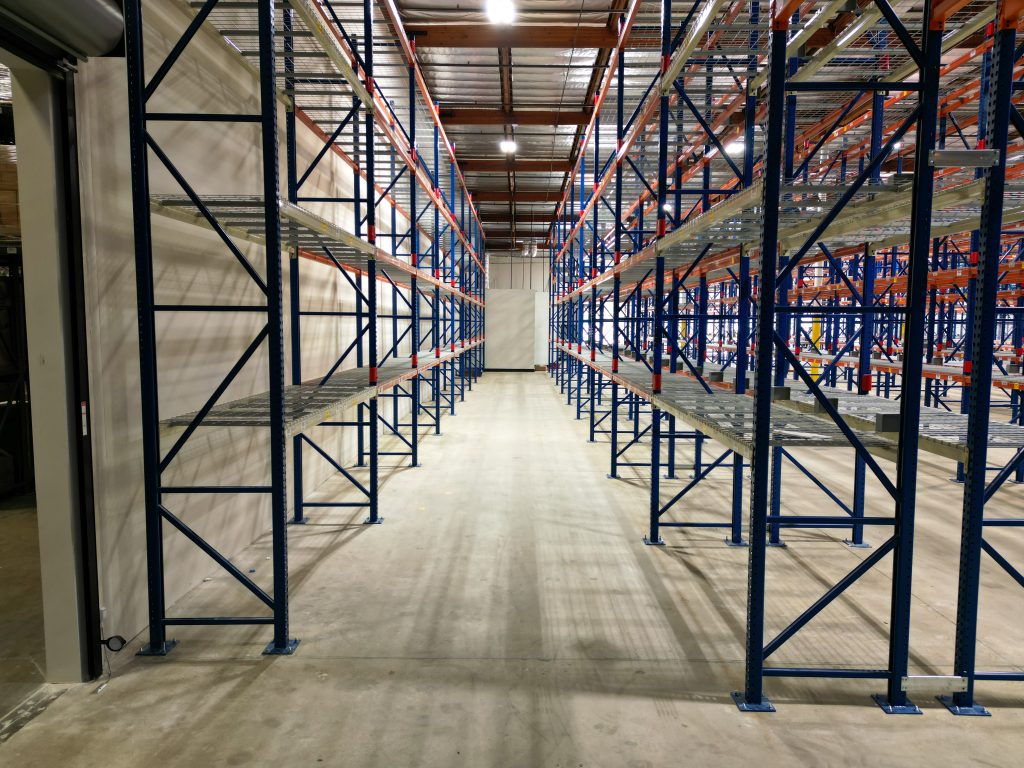
Warehouse racking is an engineered steel storage structure that holds palletized inventory off the floor and stacks it vertically, so a facility gets more warehouse storage out of the same footprint.
A pallet racking system is built from upright frames, horizontal beams and decking, engineered together to carry specific loads at specific heights. Every rack system is sized around three things, the pallet dimensions and weights you handle, the forklifts that will service it, and the clear height and column grid of your building.
That is the difference between racking and shelving. Steel shelving holds hand-stacked cases and totes. Warehouse racking carries full pallet loads, thousands of pounds per level, and has to be engineered, permitted and anchored to do it safely.
The right configuration depends on what you store and how you pick it. A high-SKU fulfillment operation needs direct access to every pallet position. A beverage distributor storing forty pallets of one SKU needs density instead. Most facilities need a mix, and that mix is what we design.
Why It Matters
Racking is usually the single largest capital item in a warehouse fit-out, and it locks in your operating costs for the next decade or more.
A layout that adds one extra storage level or narrows an aisle by twelve inches can add thousands of pallet positions to the same building. In markets where industrial space runs at a premium, that saved footprint is worth far more than the rack itself. Facilities in the Inland Empire, Dallas, Phoenix and Atlanta routinely find that a redesigned racking layout is cheaper than leasing another building.
Poorly designed racking costs you in the other direction. Aisles that are too tight slow every forklift move. Beam levels set at the wrong heights waste vertical cube. Undersized uprights fail inspection or, worse, fail under load. Damaged, unprotected columns are the leading cause of rack collapse in American warehouses.
Well-engineered warehouse racking does four things at once.
Racking Solutions
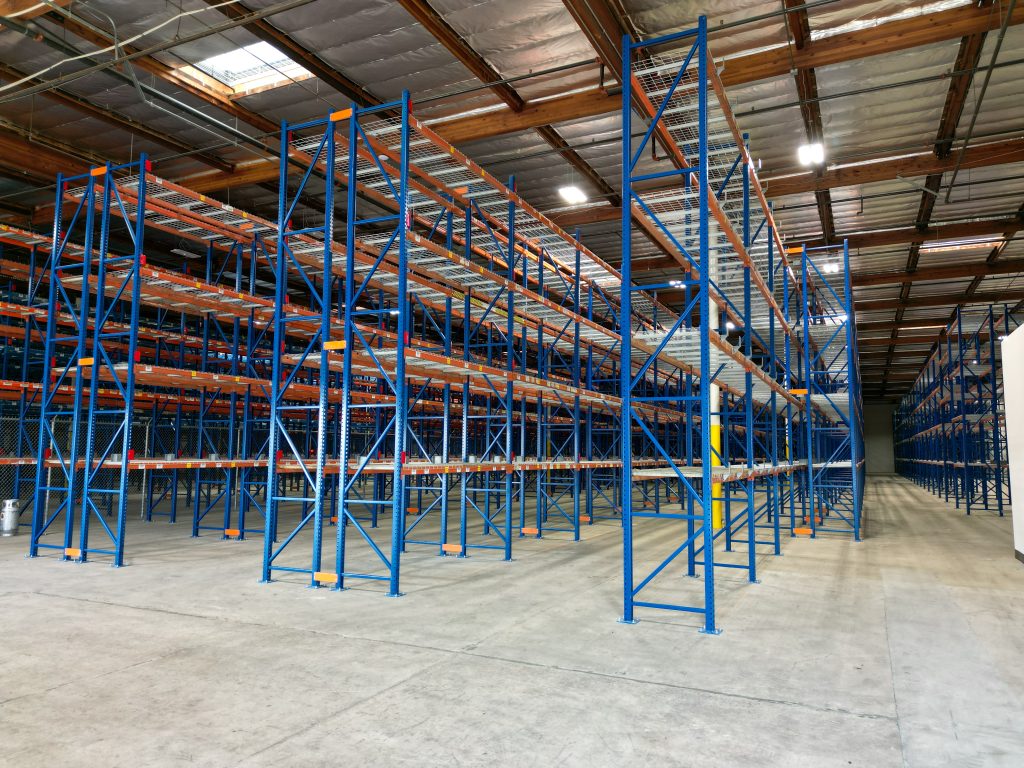
SOURCE Racks supplies and installs the full range of warehouse racking solutions. Each rack system below solves a different warehouse storage problem, and most facilities use two or three of them together.
Selective pallet racking is the most common pallet rack system in North America, and it is the majority of what we install. Every pallet position is directly accessible from the aisle, so a forklift can reach any SKU at any time without moving another pallet.
A selective rack is the right answer when you carry a lot of SKUs, when inventory turns unpredictably, or when order picking speed matters more than raw density. It is also the easiest warehouse rack to reconfigure later as your product mix changes.
Our selective pallet rack configurations include:
We also design around existing equipment. If your building already has Republic pallet rack, deep Republic pallet rack, or Hiline pallet rack in place, we can match components and extend the system rather than tearing it out and starting over. That compatibility work is one of the fastest ways to add capacity on a budget.
Learn MoreA pushback rack stores two to six pallets deep in every lane on nested inclined carts. Load a new pallet and it pushes the one behind it back down the rail. Remove one and gravity brings the next pallet forward to the aisle face.
Push back rack gives you most of the density of drive-in without sending forklifts inside the structure, which means less rack damage and faster cycle times. It runs last-in-first-out, so it suits SKUs with steady turnover rather than strict date rotation. For operations with moderate SKU counts and deep inventory per SKU, it is often the best cost per pallet position on the floor.
Learn MoreDrive in rack is the densest pallet storage available. Forklifts drive directly into the lane and set pallets on continuous rails, stacking multiple positions deep with almost no aisle space between them.
It is built for high-volume, low-SKU inventory, think seasonal goods, beverages, paper products or cold storage where every cubic foot is expensive. Because operators drive inside the structure, we specify heavier uprights, guide rails and column protection as standard, and we lay the system out so forklift traffic flows in one direction wherever possible.
Learn MorePallet flow racking is gravity-fed dense storage. Pallets load on the high side of the lane and roll forward on wheel rails or roller beds to the pick face on the other side.
Because the first pallet in is the first pallet out, a pallet flow rack enforces true FIFO rotation without any manual tracking, which makes it the standard for food, beverage, pharmaceutical and other date-sensitive inventory. It also separates loading from picking, so replenishment forklifts never cross paths with pickers. In high-throughput buildings, pallet flow racking cuts forklift travel dramatically.
Learn MoreCarton flow racking applies the same gravity principle at the case and each level. Cartons load at the back of an inclined flow rack bed and roll forward on skate wheels or rollers to a picking face, so pickers always have a full carton in front of them.
A carton flow rack is built for high-velocity case picking and fulfillment. It compresses dozens of SKUs into a short pick line, holds strict FIFO rotation, and integrates cleanly with conveyor, pick-to-light and automated retrieval workflows. Most fulfillment operations pair carton flow on the lower levels with full pallet storage above it.
Learn MoreCantilever racking stores long, bulky or awkward material that will never sit on a standard pallet. Arms extend from a central column with no front upright in the way, so a forklift or side loader can load lumber, pipe, steel tube, conduit, extrusions and sheet goods from the front.
A cantilever rack can be configured single or double sided, with straight or inclined arms, and with pipe storage cantilever rack cradles for round stock that would otherwise roll. Building supply yards, metal service centers, plumbing distributors and manufacturers across Texas and California rely on cantilever rack for material a pallet rack simply cannot hold.
Learn MoreNot everything fits a standard pallet position. We build bulk storage racks, stacking frames and portable racks for oversized, irregular or seasonal inventory, plus purpose-built industrial storage racks for specific products.
Tire rack systems are a common example. Tire distributors in Fontana, Grand Prairie and Ellenwood need racking that holds loose casings at density without crushing them, and a standard beam level will not do it. We also build coil cradles, drum racks, battery racks and secure technical storage enclosures for tooling, spare parts and controlled inventory.
For hand-stacked cases, totes and small parts, steel shelving and industrial storage systems fill the space that pallet rack would waste.
Learn MoreCatwalk systems create safe elevated access between rack rows and mezzanine levels. They let picking, replenishment and maintenance happen on multiple levels at once instead of tying up a lift for every trip upstairs, and they turn vertical air into usable working area.
Every catwalk we install is engineered with rated decking, guardrail, toe board and code-compliant stair and gate access.
Learn MoreA structural mezzanine adds a second working floor inside your existing building. It is the fastest way to add office, pick module, kitting or technical storage area without leasing more square footage or breaking ground on an addition.
Mezzanines integrate with pallet racking below and above, support conveyor and vertical lifts, and can be disassembled and moved if you relocate. In lease markets like Los Angeles County and metro Atlanta, adding a mezzanine is often a fraction of the cost of expanding.
Learn MoreComponents
Every warehouse rack is an engineered assembly. Each component carries a rated load, and swapping in the wrong part quietly reduces the capacity of the whole structure.
Two columns joined by horizontal and diagonal bracing form the vertical backbone of the rack. Frame capacity depends on steel gauge, column profile, depth and the vertical spacing between beam levels. Taller frames and wider beam spacing both reduce capacity, which is why frames are always specified alongside the layout, never separately.
Horizontal pallet rack beams carry the load and define each pallet position. Beam capacity is rated per pair, at a given length, so beam length, pallet weight and how the load bears on the beam all have to be checked together. We label every beam level with its rated capacity so your team and your inspector can read it at a glance.
Wire deck panels sit on the beams and support pallets that overhang, break down, or carry loose cases. A wire deck is required by many fire codes and insurers because it lets sprinkler water pass through instead of pooling. Wire decking also stops small items from falling into the aisle below.
We specify wire mesh decking in waterfall, flared and flat channel styles to match your beam profile, in capacities matched to your loads, including panels from manufacturers such as Husky Rack & Wire.
Cross bars that run front to back between beams. Pallet supports carry damaged pallets, plastic pallets and slip sheets that would otherwise sag or drop between beams, and they are cheaper than decking the entire level.
Column protectors, end-of-aisle guards, row spacers, wall ties, floor anchors, safety netting and rack guarding. These are the least expensive components in the system and the ones that prevent the most costly failures. Forklift impact on an unprotected column is the most common cause of rack damage we are called out to repair.
Together these parts create a racking system that carries heavy loads safely for decades, provided it is engineered, installed and inspected as one system.
Sourcing
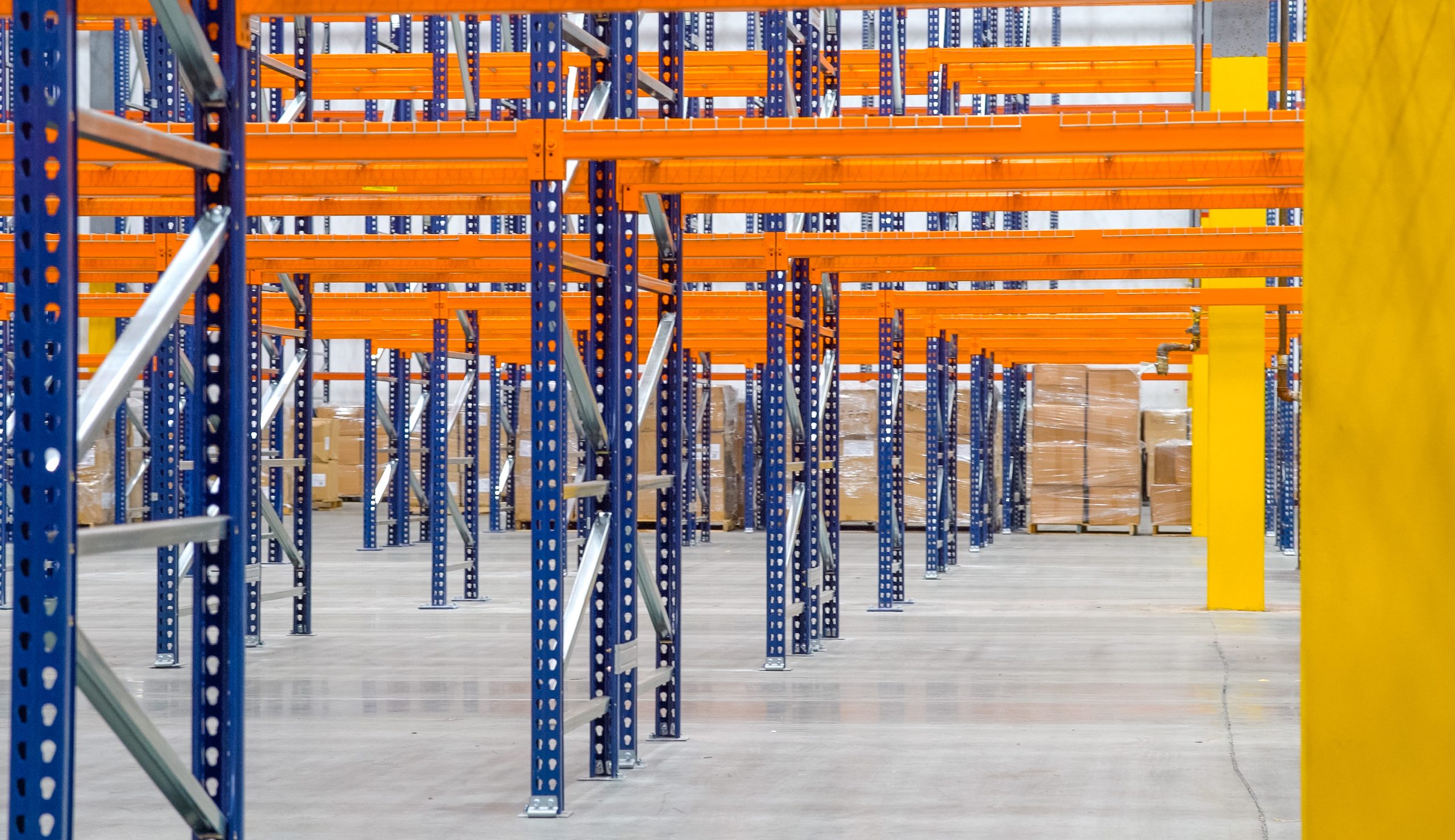
Most racking suppliers sell you whatever they stock. We source from both new manufacturing and a nationwide network of used pallet rack inventory, with regional yards near Los Angeles, Phoenix, Dallas, Chicago, Seattle, Atlanta and New Jersey.
That matters for two reasons. Used pallet racking in good structural condition typically costs a fraction of new, and sourcing from the yard closest to your building cuts freight, which on a large project can be a significant share of the total cost. Shorter shipping distance also means shorter lead times when a facility has to be operating on a fixed date.
Every used component we supply is inspected for straightness, weld integrity, corrosion and connection damage before it ships, and we provide load capacity documentation the same way we do for new material. Where a project needs new steel, whether for capacity, seismic requirements or matching an existing system, we say so.
Compliance
In California, Texas, Arizona and Georgia, storage rack installations above a certain height require permits, stamped engineering drawings and seismic calculations, and requirements differ from one jurisdiction to the next. Los Angeles County, the City of Phoenix and the Georgia fire marshal's office each want something different, and a submittal that satisfies one will not necessarily satisfy another.
We keep a dedicated permitting department for exactly this reason. Our team produces the layout drawings, seismic calculations and stamped engineering that plan checkers and fire marshals ask for, files the submittal, and works the corrections through to approval. High-piled combustible storage reviews, sprinkler clearance and flue space requirements are handled at the design stage rather than discovered during inspection.
Getting this wrong is expensive. A racking system that fails plan check has to be redesigned. A system installed without a permit can be red-tagged after it is loaded. Building it right the first time is faster and cheaper than fixing it twice.
Our Process
We handle warehouse racking projects end to end, so no part of the job falls between vendors.
We start with your inventory profile, pallet dimensions and weights, throughput, forklift fleet and growth plans, along with the building's clear height, column grid, dock configuration and sprinkler layout.
Our team produces racking layouts using AI-assisted space planning tools, which is how we turn a building drawing into a rack plan and a budget in as little as 24 hours. Experienced designers run those tools and review every output, the software just removes the slow part.
Stamped drawings, seismic calculations and permit submittal through approval.
New and used pallet rack pulled from the closest regional yard to hold down freight and lead time.
Our own crews install, anchor, level and plumb the system, then walk it with you and hand over load capacity documentation and rack safety guidance.
Buildings change. We reconfigure, repair, add levels, relocate systems and handle rack damage as your operation grows.
Racking is one piece of a working warehouse. We also handle conveyors, forklifts and material handling equipment, lighting, sprinkler coordination and automation integration, so one project team is accountable for the whole facility instead of five vendors pointing at each other.
Automation Ready
Warehouse automation no longer requires a purpose-built building. Autonomous mobile robots, robotic palletizers and goods-to-person systems can be integrated into conventional pallet racking, and retrofitting an existing facility is usually far cheaper than building a new automated one.
What automation does require is precision. Robotic systems need tighter tolerances on rack alignment, aisle width, beam elevations and floor flatness than a forklift ever will. Rack that is perfectly serviceable for a human operator can stop a robot cold. We engineer to those tolerances from the start and design aisles, upright depths and beam elevations around the equipment that will actually run in them.
We have designed racking around third-party robotics, including a recent project in Grand Prairie, Texas where the rack layout was built around a client's robotics system rather than the other way around.
Even if automation is two or three years out, designing for it now costs almost nothing and saves a rebuild later. When we lay out a racking system, we ask where the conveyor lines, charging stations and automated retrieval aisles would go, and leave room for them.
Learn More
The Payoff
Engineered warehouse racking uses full clear height and right-sizes every beam level to your actual pallet heights, which regularly adds thousands of positions in an existing footprint.
Aisle widths matched to your forklift fleet, pick faces placed where the volume is, and travel distance designed out of the layout.
Defined pallet positions make locations addressable, which is what lets a WMS give you accurate counts and lets your team find inventory without hunting.
Add bays, add levels, add lanes. A racking system designed with expansion in mind grows with the operation instead of being replaced by it.
Correctly rated components, proper anchoring, capacity signage, column protection, flue spacing and permitted installation reduce risk and keep you clear with your fire marshal and your insurer.
Used inventory, regional sourcing and a single accountable project team lower both the capital cost and the cost of coordinating the job.
Where We Work
SOURCE Racks installs warehouse racking nationwide, with concentrated coverage in the four largest logistics regions we serve.
Southern California is our home market and the densest warehouse region in the country. We work daily throughout the Inland Empire, where Ontario, Fontana, Rancho Cucamonga, Rialto, Bloomington, Jurupa Valley, Mira Loma, Riverside, Moreno Valley, Perris, Corona, Chino, San Bernardino and Redlands hold some of the largest distribution centers in North America. High land costs and tight vacancy in these submarkets are exactly why a smarter racking layout beats leasing more warehouse space.
Closer to the ports, we install pallet racking in the cross-dock and transload facilities of Los Angeles, Long Beach, Carson, Compton, Wilmington, Vernon, Commerce, Santa Fe Springs, Torrance, Gardena, Paramount and City of Industry, where fast turns and heavy import volume put real demand on a rack system. In Orange County we serve Santa Ana, Anaheim, Irvine, Buena Park, Brea and Newport Beach, and we cover Walnut, Pomona and the San Gabriel Valley corridor along the 60 freeway.
We also design and install warehouse racking systems for Central Valley and Northern California operations in Bakersfield, Fresno, Visalia, Stockton, Tracy, Lathrop and Sacramento.
California seismic requirements are among the strictest in the country. Every system we install here is engineered and permitted to meet them.
Texas is where the fastest warehouse growth in the country is happening, and we install pallet rack across all four major metros.
In Dallas-Fort Worth we work throughout the southern industrial corridor in Grand Prairie, Lancaster, Wilmer, Hutchins, DeSoto and Ferris, the Alliance corridor north of Fort Worth, and the eastern submarkets of Mesquite, Garland, Forney and Terrell, plus Arlington, Coppell, Lewisville and Flower Mound. Our BYLT project in Grand Prairie is a good example of racking engineered around a robotics system from day one.
Around Houston we install warehouse racking in northwest Houston, Katy, Brookshire, Stafford, Missouri City, Pasadena, Baytown and the Cedar Port and Bayport industrial districts, where petrochemical, resin and import distribution operations need heavy-duty structural pallet rack and cantilever rack for pipe and long goods.
In San Antonio and the I-35 corridor we serve Schertz, Selma, Cibolo, New Braunfels, San Marcos, Round Rock and Austin. On the border, Laredo's World Trade Bridge corridor and El Paso's cross-dock facilities handle enormous cross-border freight volume, and both run on racking that has to turn inventory fast.
Phoenix has become the overflow distribution hub for the West Coast, and the West Valley is where most of that space has been built. We install warehouse racking systems in Tolleson, Goodyear, Avondale, Buckeye, Glendale, Litchfield Park and Surprise along the I-10 corridor, plus the Southeast Valley markets of Chandler, Mesa, Gilbert, Tempe and Queen Creek.
Along the I-10 between Phoenix and Tucson we serve Casa Grande, Coolidge and Eloy, where large fulfillment and manufacturing campuses have opened in recent years. In southern Arizona we cover Tucson, Marana, Vail and the Nogales produce corridor, where cold storage operations need racking specified for refrigerated and freezer environments. We also serve Flagstaff, Prescott and Yuma.
Arizona's building volume means plan check timelines matter. Our permitting team files in Phoenix, Maricopa County, Pima County and the surrounding jurisdictions regularly.
Metro Atlanta is the distribution center of the Southeast, and we install warehouse pallet racking across it. In the southern crescent we work in McDonough, Locust Grove, Stockbridge, Ellenwood, Jonesboro, Fairburn, Union City and Palmetto. West of the city we serve Austell, Lithia Springs, Douglasville, Mableton and Villa Rica, and to the northeast we cover Braselton, Buford, Suwanee, Jefferson, Commerce and Gainesville along the I-85 corridor.
The Port of Savannah is the fastest-growing container port in the country, and the warehouse development around it is growing with it. We install racking systems in Garden City, Pooler, Port Wentworth, Rincon, Bloomingdale and Effingham County, along with Statesboro and the surrounding distribution market.
We also serve Macon, Columbus, Cartersville, Calhoun, Dalton and Augusta, including the flooring and manufacturing operations along I-75 in northwest Georgia that need cantilever racking and heavy structural systems.
Outside these four states, we install warehouse racking nationwide, sourcing from regional yards in Seattle, Los Angeles, Phoenix, Dallas, Chicago, Atlanta and New Jersey to keep freight costs and lead times down no matter where your facility sits.
Questions
Cost depends on the rack type, load capacity, height and how many pallet positions you need. Selective pallet racking is the lowest cost per bay but uses the most aisle space, while push back rack, drive in rack and pallet flow rack cost more per bay and far less per pallet stored. Used pallet rack in sound condition typically runs well below new. The most useful number is cost per pallet position, and we can give you that within 24 hours of receiving your building drawing.
Selective racking gives a forklift direct access to every pallet, which is best for high SKU counts and fast picking. Drive in rack stores pallets several positions deep with forklifts entering the structure, which stores far more pallets in the same area but only works well when you have many pallets of the same SKU.
In most jurisdictions across California, Texas, Arizona and Georgia, yes, once the racking passes a defined height, and high-piled combustible storage triggers a separate fire review. Requirements and thresholds vary by city and county. Our permitting department handles drawings, seismic calculations and submittals for every project we install.
Usually. If we can identify the manufacturer and connection style, whether that is teardrop, Republic, Hiline or structural, we can match components and extend the system. We check that existing frames still carry the load you plan to add before anything gets installed.
Estimates go out within 24 hours. From approved design, most projects run a few weeks to a few months depending on permit timelines, material availability and the size of the installation. Sourcing used inventory from a nearby regional yard is often what pulls a schedule in.
Yes, when it is inspected and documented properly. We check straightness, welds, corrosion and connector damage on every used component, supply load capacity documentation, and reject anything that does not pass. Used rack that has been repaired without engineering approval is what you have to watch out for, which is why sourcing matters.
Wire decking is a steel mesh panel that sits on the beams to support loads. Many fire codes and insurers require it because it lets sprinkler water through, and it stops cartons and small items from falling into the aisle. If you store anything other than perfectly sized, structurally sound pallets, you almost certainly need it.
Often, yes. Autonomous mobile robots and goods-to-person systems can be integrated into conventional racking, though they require tighter tolerances on alignment, aisle width and floor flatness. We assess existing systems for automation readiness and design new ones to accommodate it.
Cantilever racking. Arms extend from a central column with nothing blocking the front, so long material loads and unloads from the aisle. Pipe storage cantilever rack cradles keep round stock from rolling.
Yes. We install nationwide, with heavy concentration in California, Texas, Arizona and Georgia, and we source from regional yards across the country so freight does not eat the project budget.
Get Started
Send us your building drawing and pallet information and our team will come back with a racking layout and a budget within one business day. Design, engineering, permitting, sourcing and installation, handled by one team.