
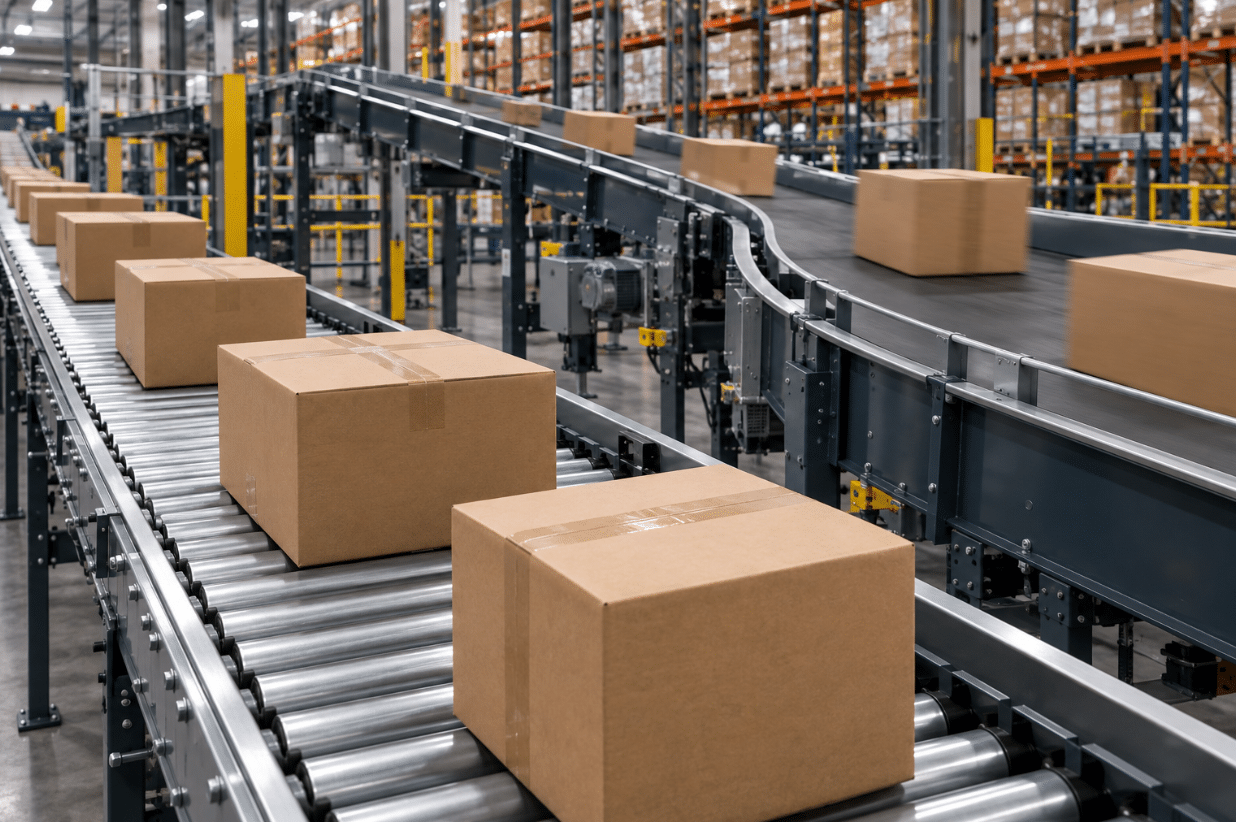
Every busy warehouse eventually hits the same wall. Orders climb, aisles get crowded, and the team spends more time carrying product than picking it. Warehouse conveyor systems are how high performing operations break through that wall, turning slow hand carrying into a steady, predictable flow of goods. A well designed conveyor system moves cartons, totes, and pallets from receiving to shipping with less labor, fewer errors, and far more throughput.
At SOURCE Racks, we design warehouse layouts where racking and conveyor systems work together, so this guide breaks down how these systems work, the main conveyor types, and how to choose the right conveyor system for your operation. A strong conveyor system is not one machine but a coordinated line built around how your warehouse operations already run.
What Warehouse Conveyor Systems Actually Do
A conveyor system is a network of powered or gravity driven equipment that transports product along a fixed path. Instead of a worker walking a tote across the building, the conveyor moves it. In a modern warehouse, a conveyor system connects receiving, storage, picking, packing, and shipping into one continuous line. That connection is what makes warehouse conveyors so valuable. They reduce hand carrying, shorten travel time, and let your team focus on tasks that add value.
The payoff shows up across the whole warehouse operation. Product moves faster, labor costs drop, and accuracy improves because fewer hands touch each item. As order volume grows, a conveyor system scales with you in a way that adding people never can. For any warehouse chasing more throughput, a conveyor system is one of the first upgrades worth serious study.
The Main Types of Conveyor Systems
No two warehouses flow the same way, so conveyor systems come in many forms. Understanding the main conveyor types helps you match each conveyor to your product and your building.
Roller conveyors are the workhorse of most facilities. A roller conveyor uses a series of parallel rollers to move flat bottomed cartons and totes. Gravity roller conveyors need no power at all, letting product roll down a slight decline, while a powered roller conveyor or motorized roller conveyor drives the rollers for precise control. Line shaft conveyors and a simple gravity roller conveyor are common in picking and packing zones where cost and simplicity matter, and roller conveyors handle the bulk of carton movement in most buildings.
Belt conveyors handle what rollers cannot. A belt conveyor runs a continuous conveyor belt over a solid bed, which makes belt conveyors ideal for small, irregular, or fragile items that would fall between rollers. Conveyor belts also grip product on inclines and declines, so belt conveyors move goods between floors and mezzanine levels. Warehouse conveyor belts are a staple in e commerce fulfillment, where speed and gentle handling both matter, and a smooth conveyor belt protects delicate goods that rollers would jostle. A well tensioned conveyor belt runs quietly for years, and modern conveyor belts come in cleated, roller bed, and cleanroom grades to match the product.
Beyond rollers and belts, specialized conveyors solve specific problems. A chain conveyor moves pallets and bulky loads that would crush lighter equipment, and heavy duty chain conveyors are built for that punishment. A pallet conveyor carries full pallets between docks, storage, and staging, and pallet conveyors keep heavy loads moving without a forklift. Overhead conveyors free up valuable floor space by routing product above the work area, and an overhead conveyor is ideal when the floor is already full. A spiral conveyor lifts cartons vertically in a tight footprint, while a slat conveyor uses linked slats to carry hot, heavy, or awkward items.
For high volume distribution, accumulation conveyors buffer product without pressure so items queue smoothly, and an accumulation conveyor prevents jams at busy merges. Sortation conveyors divert cartons to the right lane, dock, or chute automatically. Transportation conveyors carry product over long runs across the building, and modular conveyors let you reconfigure the line as your needs change. Brands like Dorner conveyors are known for precise, modular belt and roller sections.
From Manual Handling to Warehouse Automation
The real leap happens when conveyors connect to controls and software. An automated conveyor system uses sensors, scanners, and logic to route product with little human input. Scaled up, automated conveyor systems and automated conveyors form the backbone of warehouse automation, moving thousands of orders an hour with barcode driven accuracy.
Conveyor automation rarely works alone. In an advanced distribution center, conveyors feed an automated storage and retrieval system, hand product to automated guided vehicles, and coordinate with reach trucks for putaway. Automated storage keeps inventory dense and accessible, while the retrieval system delivers the right tote to the right station on demand. Together, these tools turn a traditional warehouse operation into a tightly choreographed flow, and warehouse automation stops being a buzzword and starts paying for itself.
How to Choose the Right Conveyor System
The best conveyor system starts with your product, not the equipment. Ask what you move, how much, and how far, then match the answer to the conveyor type that fits.
Product and weight come first. Light cartons suit a roller conveyor or belt conveyor line, while pallets need a chain conveyor or pallet conveyor built for the load. Throughput comes next. Steady, high volume flow justifies powered and automated conveyor systems, while low volume zones may only need gravity conveyors that cost almost nothing to run. Layout and space matter too. Overhead conveyors and a spiral conveyor reclaim floor space, and modular conveyors adapt to odd shaped buildings. Finally, weigh budget and growth. A gravity roller conveyor costs little up front, while a fully automated conveyor system is an investment that pays back in labor over time.
The best conveyor solution usually blends several conveyor types into one system. A smart conveyor solution matches each zone to the equipment that fits it, then ties everything back to your storage and your material handling flow. Get it right and your warehouse operations run leaner every shift.
Where Racking Meets Conveyor Systems
Conveyor systems and pallet racking are two halves of the same warehouse. Product that flows in on a conveyor still has to live somewhere, and how your racking is laid out decides how well the conveyor performs. This is where SOURCE Racks fits in. We design warehouse layouts and material handling systems where racking, workflow, and conveyor systems line up, so your building runs as one system instead of a set of disconnected parts. Designed this way, a conveyor system multiplies the value of every rack.
Whether you are planning a new distribution center or upgrading warehouse operations in an existing building, the goal is the same. Move product with less manual handling, less wasted travel, and less risk. Well planned warehouse conveyor systems, built around smart racking and material handling, get you there, and the payoff compounds every year as your volume grows.
Move Your Warehouse Forward
Warehouse conveyor systems are one of the highest return upgrades a growing operation can make. They cut labor, speed throughput, and give your team room to scale. If you are ready to design a warehouse where racking and conveyor systems work together, SOURCE Racks can help. Contact us for a fast estimate and put your material handling plan in motion.